
We Actually Get to Build This!


A week or so ago my mom, who lives in Phoenix, told me the forecasted high temperature was 105 degrees, while it was still technically winter. I grew up there, and that absolutely smashes the record for the earliest hundred-degree day the city has ever seen. When I describe the the latest book on climate risks that I’m reading to my girlfriend, I can see the discomfort settle across her face in real-time. From AMOC weakening in the next decade or two, to coral reefs already crossing tipping points, to the cascading feedbacks that could start slipping beyond our ability to respond, this is indeed kind of overwhelming to think about! It all melts into this fog of compounding bad news where everything destabilizing blurs together and it becomes hard to feel anything other than paralyzed.
I’ve written a lot about that dread and the specific risks behind it. I’ve argued that carbon removal won’t scale fast enough, that a narrative vacuum around cooling interventions is being filled by conspiracy theorists, and that we need a climate stabilization framework to make sense of the full range of interventions that could keep Earth systems from crossing points of no return. If you’re new to this newsletter, those links will catch you up.
What I want to add to that picture is that I think the climate stabilization field’s approach to public engagement is missing a dimension. The work I’ve been doing on permission space is real and important, especially among the funders and policymakers who control the resources this work needs. But permission is not sufficient on its own. We also have an imagination problem, and I don’t think enough of us are taking it seriously.
When people in this field talk publicly about climate interventions, the most positive it ever gets is “this is a grim necessity." The most optimistic framing available is something like: these tools are terrifying, but if we’re careful and we build the right governance, they might be less terrifying than the alternative. I’ve more or less said the same thing myself, and it’s at least correct on the facts. But I’ve started to think it’s insufficient for what we actually need, which is sustained democratic support for some of the most expensive and ambitious engineering projects in human history. We need the kind of support that doesn’t evaporate the first time a political coalition shifts or a budget fight gets ugly.
It’s a bit cliche, but I want to draw a comparison to the Apollo program. Some people might assume the Moon landings were carried along by a wave of popular enthusiasm, but that’s a myth. The Harris Poll surveyed Americans throughout the 1960s, and a majority never thought Apollo was worth the cost. In 1967, 54% said the four billion dollar price tag wasn’t justified. 57% would have rather spent the money on water desalinization. When asked in the same year whether they’d support the program if the Russians weren’t in space, 61% said no. Apollo ran on Cold War geopolitics, not democratic enthusiasm.
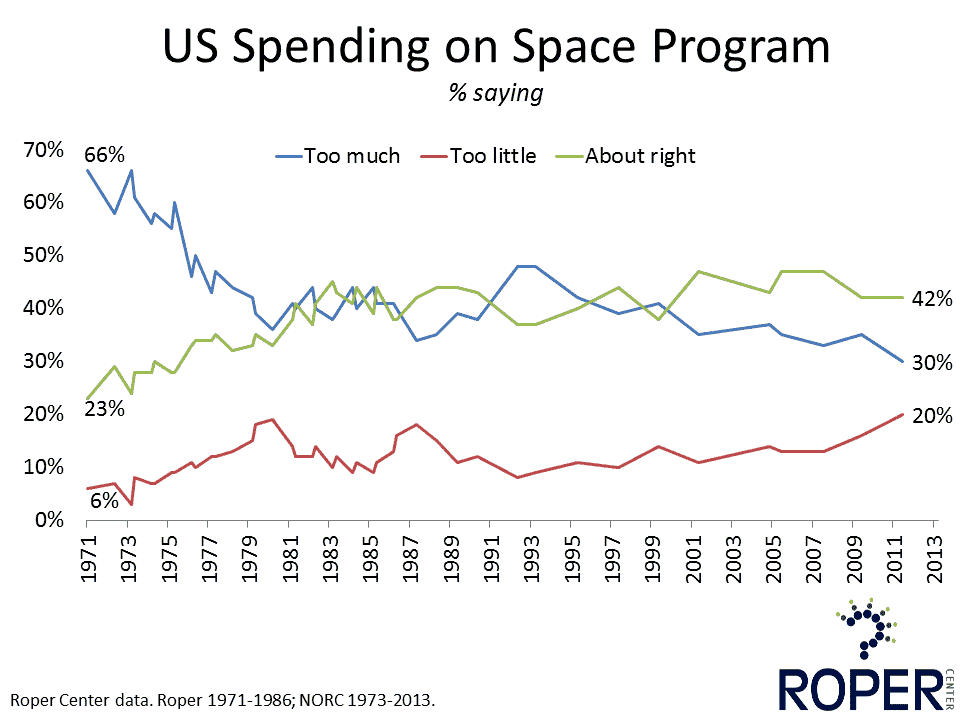
And yet the cultural penetration of the space age was real and enormous. Ninety-three percent of American households watched the Apollo 11 landing. Fashion designers like André Courrèges, Paco Rabanne and Rudi Gernreich built entire fashion lines around space-age aesthetics. Star Trek, The Jetsons, 2001: A Space Odyssey, and all sorts of science fiction that imagined humanity reaching for the stars were all published then. People thought space was cool even while telling pollsters they’d rather spend the money on something else. The imagination and the poll numbers operated somewhat independently of each other.


What does that mean for climate interventions? It means we can’t rely on a geopolitical forcing function like the Cold War to carry the politics. There is no Soviet Union in this race. Which means the cultural imagination piece might matter even more than it did for Apollo, because without that captivation, without people being able to see a future they actually want to live in, the political will for sustained, expensive, multi-decade engineering programs is going to be incredibly fragile. And yes, I understand how ridiculous it sounds to talk about sustained international cooperation and multi-decade political commitment in this particular political moment. And yet we still have to figure out how to do it, because the physics doesn’t care about our election cycles.
I believe that the things we are going to have to build to stabilize this planet are some of the most extraordinary engineering challenges in human history, and almost nobody is talking about them that way.
I mean, just look at glacier and ice sheet stabilization. I’ve written about the blurry line between adaptation and geoengineering before, and ice is where that distinction breaks down most obviously. The Thwaites Glacier in West Antarctica, which glaciologists call the Doomsday Glacier because its collapse could eventually raise sea levels by over two feet on its own(!), is grounded on bedrock below sea level in a configuration that makes it inherently unstable as warm water eats away at the grounding line. Proposals to intervene involve building structures on the seafloor in some of the most hostile conditions on Earth. We’re talking about working at depth, in near-freezing water, under ice shelves, deploying a massive underwater civil engineering project to redirect warm ocean currents in the most environmentally harsh location on the planet. And this kind of thing isn’t purely hypothetical anymore, at least in the Arctic north. Groups like Real Ice are building autonomous underwater drones designed to help refreeze Arctic sea ice, and Arctic Reflections is running experiments pumping seawater onto existing ice to thicken it. These are early-stage efforts, but they’re real hardware being tested in real conditions. The engineering challenges are immense and they’re also, honestly, really cool.
Or let’s look at coral reef protection. The Australian Reef Restoration and Adaptation Program is already testing marine cloud brightening as a shading mechanism for the Great Barrier Reef, trying to figure out whether you can generate enough localized cooling to reduce bleaching stress during heat events. Other researchers at Undercurrent are experimenting with nanobubble cooling. Groups are designing physical shading structures. This is an entirely new category of ecosystem engineering, and it’s happening now because the reefs can’t wait for emissions reductions to save them, the thermal stress is already here. Scaling any of these approaches means inventing monitoring systems and deployment methods and feedback loops that don’t exist yet, combining atmospheric science and marine biology and engineering into something nobody has a name for.
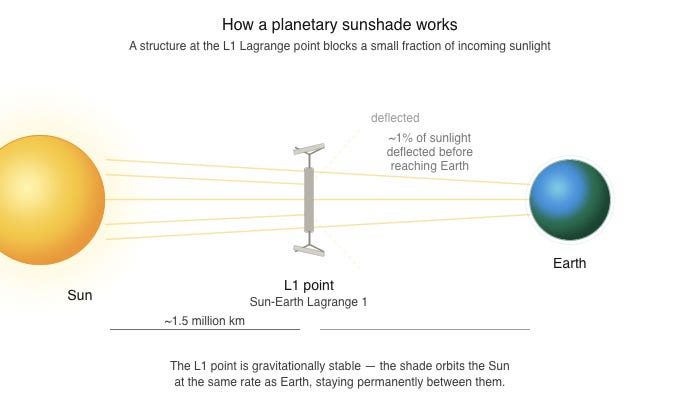
And then there are the ideas that were literally science fiction. These are space-based sunshades, reflectors positioned in orbit to deflect a fraction of incoming sunlight before it reaches the atmosphere. Arthur C. Clarke and Isaac Asimov wrote about solar sails and orbital construction, not because they were imagining climate interventions (nobody was worried about warming in the 1950s) but because they understood that humanity’s relationship with space would eventually become an engineering relationship, not just an exploratory one. The Planetary Sunshade Foundation is working on this today. And one of the things that makes it so fascinating is the mass problem: you very likely can’t launch enough material from Earth to build reflectors at the scale that would matter (too expensive), which means you’d need to harvest aluminum and silicon from the Moon and manufacture components in space. As someone who has read most of Clarke and Heinlein and who devoured The Expanse series, I find it genuinely remarkable that some version of the industrial space economy those authors imagined might become necessary in my lifetime not as exploration or commerce but as planetary self-defense.
And for anyone reading this who thinks that sounds ludicrous and impossibly far from where we are today: we went from basic machine learning algorithms to a serious global debate about whether we’ve achieved artificial general intelligence (AGI) in roughly a decade. Things move fast. Exponential technological growth is not a metaphor anymore, it’s the actual trajectory we’re on, and the exponential part is really starting to kick in.
I should explain why I look at all of this and feel what I feel, because I realize that looking at a list of planetary emergencies and getting excited is not the default response. I grew up building computers with my dad, spent my teenage years reading Heinlein and Clarke and Crichton and watching Star Trek and Stargate SG-1. I built a Hackintosh (a desktop PC running a hacked version of Mac OS X) when I was sixteen and felt like I’d unlocked something fundamental about what was possible if you were willing to just figure things out. I’m an engineer at heart. When I look at the portfolio of interventions we’re going to need to stabilize the climate system, I feel something I wouldn’t expect to feel after years of staring at increasingly alarming data: I feel excited. The problems are enormous and the things we're going to have to build to address them are correspondingly wild. I think it matters that some of us feel that way and say so.
The field right now is so worried about triggering moral hazard objections that it has overcorrected into a posture where the only acceptable register is solemnity and reluctance. I even find myself doing this too. And the crazy thing is, most of us working in this space don't actually think the moral hazard concern is a strong enough reason not to pursue the research. The risks of inaction are far worse than the risks of someone misusing cooling as an excuse to keep polluting. But we still talk about it like we're apologizing for being in the room. The result is that we've collectively made it very difficult to generate enthusiasm about the work, and in doing so we've cut ourselves off from one of the most powerful forces available for building the kind of broad, durable public support that these projects are actually going to require.
And this is not techno-optimism in the lazy sense. It drives me a little bit crazy when people like Sam Altman wave their hands about how artificial superintelligence will solve climate change. Bits are not atoms. You cannot prompt-engineer your way to a glacier stabilization system. We have to actually build these things, in the real world, with real materials and real institutions and real international cooperation. The physical infrastructure for climate stabilization is going to require the kind of sustained collective effort that software startups have never had to contemplate. To paraphrase Stewart Brand, we are the planetary stewards now, whether we feel ready for it or not, and we can’t hand that responsibility off to an AI model and go get coffee.
But I am saying that we are capable of building enormously complicated things when we decide to, and that the challenges of climate stabilization represent an opportunity to rebuild something we’ve lost. People want to trust their institutions. People want to believe that large-scale collective action is possible. The cynicism of the current moment is real, but underneath it there’s a hunger for something worth doing together, something that matters, something where the engineering and the governance and the international coordination are all hard problems that we get to solve because solving them literally saves lives. When I get asked “how do you keep working on this?” the honest answer is that I love solving problems, and I can’t imagine a bigger or more interesting set of problems than figuring out how humanity stabilizes its own climate system. That includes the social and political challenges too. How do we build governance for planetary-scale interventions? How do we get institutional buy-in across countries with fundamentally different interests? Those are fascinating problems. Hard, yes. But fascinating!
We’re the generation that gets to attempt these things. I don’t know yet whether we’ll succeed, but I know that treating the attempt only as a grim obligation, and never allowing ourselves or anyone else to notice that it’s also one of the most extraordinary collective endeavors humans have ever undertaken, seems like a mistake we can’t afford. More of us should be willing to say, out loud, that this work is amazing, and the world is going to need to hear that if we’re actually going to build any of it.
This and every other article I publish is free because I want these ideas to reach as many people as possible. Paid subscriptions are how I keep doing this work independently. They allow me to follow the research on climate interventions and meet the researchers, practitioners, founders, and policymakers shaping how this landscape evolves.
Paid members get access to our community chat, where we discuss the latest developments in climate interventions and make sense of them together. I’m sharing all the really interesting videos, papers, stories, and other links I’m coming across in there. If you’ve found value in this newsletter, I’d appreciate your support.
Paul, you struck the nail on the head when you mentioned we need more sustained collaboration on support for workable and, more importantly, climate fixes scoped to help resolve the true direness. I hope more heed Dr. Hansen and all these disparate climate groups unite and stop calling desperate fixes to be researched "moral hazards".
The moral hazard, to me, is blatantly closing one's eyes to the severity, not listening to the most notable climate scientist, and refusing to accept that drawdown alone, even if ramped up, alone screws humanity.
Hi Paul. Love your stuff. Let´s talk online about the SeabedCurtain.org idea.
Warm and optimistic regards,
Marianne Hagen
Co-lead Seabed Curtain Project
Marianne.hagen@niva.no