
Observations From the Climate Stabilization Field
What we learned from three months and 29 interviews inside the climate stabilization field, and what we're building next.

Ben Lachman and I spent the spring studying the climate stabilization field. We conducted 29 interviews, co-hosted a framing experiment at SF Climate Week, and produced a short observations report, which is attached below. This piece shares that report and what we’re doing next.
Related: the Global Risk and Stabilization Summit happens October 12-13 in Iceland, and you can apply to attend at globalstabilization.org.
A little over a year ago, in July 2025, I spent four days at the Global Tipping Points conference in Exeter, listening to scientists lay out what happens if the Amazon tips into savannah or the Atlantic circulation shuts down, and then watching much of that same community treat the question of directly intervening in those systems as unfit for polite discussion. I wrote about that experience at the time, and I came home feeling radicalized. If these risks are as serious as the science says, then preparing to respond to them requires an enormous amount of work that has barely started: governance structures, social legitimacy, community engagement, and public narratives, in addition to all the engineering, field research, funding pipelines, and talent pipelines that any technical field needs.
The situation was worse than just an early start, though, because many of the people best positioned to argue for that preparation were instead arguing against it. I’ve written about the resulting dynamics before: the taboo blocks the funding, the missing funding blocks the people, and the missing people guarantee the work stays undone, which keeps the whole subject easy to dismiss.
So in the fall of last year I went out and pitched a project plan. I was calling it the Stabilization Plan, modeled loosely on Leopold Aschenbrenner’s Situational Awareness, and the idea was a targeted informational campaign making the case for climate stabilization to the audiences whose permission matters most. I eventually laid out the thinking here in this newsletter in The Climate Stabilization Framework. I pitched it to philanthropies the way I had pitched Nori to venture capitalists, because that was the fundraising I knew how to do, and it turns out that’s not how you raise nonprofit money (oops). The feedback I got was remarkably consistent. Why start a new organization when the work would make more sense housed inside an existing one? And could the scope come down to something milestone-based rather than one grand campaign? Both pieces of feedback turned out to be right.
That’s when I had the good fortune of talking with Joshua Elliott, the chief scientist of Renaissance Philanthropy’s Advanced Research for Climate Emergencies (ARC) program, who was interested in exactly this narrative dimension of the climate intervention space. I had also met Ben Lachman at a Climate Emergencies Forum workshop during New York Climate Week, a longtime entrepreneur whose background runs from software and hardware through fifteen years of climate mitigation work, and he became my partner in all of this. Together with Joshua we scoped a three-month research pilot, which kicked off in February.
If you come from the for-profit world, you would recognize what we did as customer discovery. We conducted 29 formal interviews with funders, researchers, practitioners, and policy actors around the world who work on climate interventions, asking where people get blocked, how fundraising actually goes, and what the politics look like, spoken and unspoken. We deliberately scoped the research to three risk domains: coral reefs, the cluster of Arctic risks, and permafrost. We chose those domains because when mainstream media writes about geoengineering it is almost always writing about stratospheric aerosol injection, and we wanted to test whether other interventions could be disaggregated from SAI. You do need planetary-scale governance for SAI, but you don’t need planetary-scale governance in place to start experimenting with marine cloud brightening to shade a specific local coral reef, for example. The prerequisites are fewer, and the work could start sooner.
We also ran a live test of the framing. In April we co-hosted an event during SF Climate Week called Stabilize Earth, which I wrote about at the time, and which turned out to be one of the field’s largest semi-public gatherings to date. All of this fed into a short observations report, where we acknowledged the biases plainly. We were very much talking to the converted, so the observations reflect converging views within the field rather than the views of the public or of skeptics.
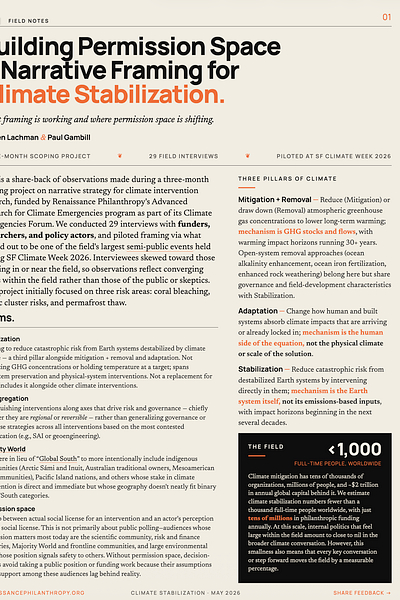
(Download the report above or click here to open in a browser.)
The example that best captures the state of this field is permafrost. The frozen ground of the boreal north holds roughly twice as much carbon as the entire atmosphere, and under continued high warming, published estimates of what could escape as CO2 and methane by 2100 run to hundreds of gigatons of CO2-equivalent. When you ask people how many researchers worldwide are working directly on keeping permafrost frozen (not counting generic GHG mitigation efforts), even people who work in climate, almost nobody guesses anywhere near the real answer, which is a handful at most. That contrast between the scale of a risk and the number of people working on it repeats across the whole field.
By our estimate, all of climate stabilization runs on fewer than a thousand full-time people worldwide and on the order of tens of millions of philanthropic dollars per year. Climate mitigation, for comparison, has tens of thousands of organizations, millions of people, and roughly two trillion dollars a year in capital behind it. None of this takes anything away from mitigation, which as Ben likes to put it is the boulder already rolling downhill, just not quite fast enough. But the comparison is still valid, because this shows what happens to a category of climate response when the subject stays taboo long enough that people and funding never arrive.
The full report contains nine observations, and I would rather you read them than my summary of them, but a few are worth pulling forward here. Risk-first framing opens doors that solution-first framing closes. Latent support is larger than visible support, because speaking up in this field carries asymmetric career risk, and as we put it in the report, silence in this field is not opposition. Philanthropic capital follows institutional cover, not just conviction. Majority World institutional engagement with intervention research, in India and in Ghana among others, is moving faster than many Western observers realize. And nearly half of our interviewees independently named some version of the same missing piece: connective infrastructure that the field does not yet have.
That last observation is the one Ben and I are now acting on. Following the pilot, we joined Renaissance Philanthropy to lead the Climate Emergencies Forum and evolve it from the convening body it has been since 2024 into a proactive field-building organization. Our logic is that the destabilization of these Earth systems will eventually force governments to fund stabilization research and readiness at billions of dollars per year, and whether that capital arrives in time, and whether it lands well, depends on what exists to receive it. Absorbing investment at that scale takes people, institutions, de-risked science and engineering, and public legitimacy, and today the field is short on every one of those dimensions. Closing that gap within roughly a decade means working on three problems now.
The field needs more philanthropic capital. Tens of millions of dollars per year is the current reality, and most of it has gone to global sunlight-reflection approaches rather than the broader portfolio of system-specific interventions. We think this needs to grow by two orders of magnitude within about ten years, and in the near term that growth mostly has to come from philanthropy, because philanthropic capital is what grows a field to the point where governments can fund it seriously. (I plan to write separately about the role of for-profit companies in stabilization, which I think is real but different.)
The field needs more people. There are hundreds of full-time people today, and we would like to see tens of thousands within ten years. Permafrost is the extreme case, but the pattern repeats across the risk domains where there are whole categories of problems that essentially no one is working on. Ben and I have already been fielding calls from seasoned entrepreneurs who attended Stabilize Earth and want to contribute without knowing where to start, which tells us the on-ramps matter as much as the recruiting.
The field needs common groundwork. The most consistent finding across our interviews was that the field lacks shared infrastructure that no single organization can build for itself, so each one rebuilds it alone. That groundwork starts with shared definitions and frameworks that let a program officer or a newcomer place stabilization in context, and a shared map of the risks, the interventions, the funding, and the gaps, similar in ambition to what Frontier’s gap database did for carbon removal. It extends to the community-engagement protocols, governance frameworks, and regulatory strategy guides that every new organization currently reinvents from scratch. All of that duplicated effort slows everyone down and keeps the field hard for incoming talent and capital to find.
Offering stabilization as a name is part of the same work. This field has been forming whether anyone names it or not. We’re suggesting a name so that the people already doing the work can find each other, and so that funders and newcomers can find them, because you can’t recruit someone into a field that officially doesn’t exist.
Which brings me to the summit. In October, CEF is convening the Global Risk and Stabilization Summit in Iceland, October 12 and 13, intended as the field-wide gathering. There will be several hundred people in attendance, with the goals of building a shared picture of the field’s current state and creating the collaborations it needs next. If you are working in or want to work in this field, you can apply to join us directly at globalstabilization.org. I hope to see many of you there.
The report remains open for feedback, and the form linked inside it still works. We have already received a lot, especially on the word stabilization itself, where the objections have been good enough that they deserve their own article. That piece will come next.
Curious what you think about the following commentary:
https://africantechfutures.org/insights/selling-stability