

Ted Nordhaus published Why I Oppose Solar Geoengineering in The Ecomodernist today. He has been a serious and independent voice on climate for a long time, and his piece deserves a serious reply rather than a pile-on. This is my attempt at one.
Ted Nordhaus is a hard person to dismiss on this subject. By his own account he has been supportive of geoengineering research over the years: he argued in Foreign Affairs in 2018 that the two degree target created its own moral hazard by making adaptation and geoengineering research look unnecessary, he suggested in his review of Elizabeth Kolbert's Under a White Sky that future societies might engineer the climate to preserve biodiversity, and in 2024 he proposed using marine cloud brightening to moderate the natural climate swings of the El Niño cycle. When someone with that record announces that he now doubts the wisdom of even the research, it's worth finding out where the argument goes wrong.
And he gets a lot right. The break-glass-in-case-of-emergency framing deserves to die. There is no observable threshold where the world will agree that the emergency has arrived, and if we wait for one, we will have waited too long, because interventions at meaningful scale have lead times measured in years while the outcomes worth preventing become unpreventable quietly, well before they become undeniable. I used the framing myself when I first started writing about climate interventions; one of my early pieces is literally titled Break Glass, Cool Planet. What moved me off it was Oliver Morton’s The Planet Remade, which makes the best case against the emergency framing I’ve read. A technology you only reach for once the catastrophe is obvious is a technology you reach for too late.
He is also right that humanity has, so far and in aggregate, adapted faster than the climate has changed. Climate-related mortality has fallen dramatically over the past century, and disaster losses have stayed roughly flat as a share of the wealth exposed to them. Those trends are real, and parts of the climate movement do themselves no favors by pretending otherwise. The aggregate hides a great deal, since the adaptive capacity sits mostly in rich countries while the residual risk sits mostly everywhere else, but the direction of the trend is what he says it is. And he is right that catastrophism runs through parts of the climate conversation, the strain that gave us deadlines like twelve years to save the world, and that some advocates of cooling research have picked up the habit, describing the present as already catastrophic partly because catastrophe justifies the tool. That drift is real, I have watched it happen, and it deserves the criticism.
So I agree with more of his premises than I expected to when I opened the piece. The argument still fails, and it fails at one specific step. Ted claims that rapid climate change, the kind that outruns adaptation, is “almost singularly associated with geoengineering termination shock.” Most of the essay leans on that sentence, and the sentence is wrong.
Where the argument turns
His strongest argument runs something like this: human societies handle slow change well and fast change badly, so the rate of change matters as much as the magnitude; anthropogenic warming has been fast on geological timescales but slow on human ones, which is why adaptation has kept pace; termination shock would compress decades of warming into a few years, which adaptation cannot absorb; therefore the technology built to manage climate risk is the one thing that could turn a manageable problem into a catastrophe. As far as the mechanism goes, I think he is correct: speed, more than size, is what breaks adaptation.
Where he goes wrong is in believing the Earth system only moves fast when people push it. The Greenland ice cores record more than two dozen episodes during the last ice age, the Dansgaard-Oeschger events, in which temperatures over Greenland jumped by 8 to 16 degrees Celsius within a few decades. The driver was the Atlantic ocean circulation abruptly reorganizing itself. No one was flying stratospheric aircraft in the ice age. The climate did that on its own, repeatedly, and the same circulation is the one making headlines today as the AMOC, whose stability is an open research question: one much-debated study put a possible collapse near the middle of this century, another found it on course to tip without saying when, and others argue the observational record is too short to predict anything at all. That disagreement is the uncomfortable part, because it means we are leaning our weight on a system with known fast failure modes without knowing how close the edge is. The same concern applies to the West Antarctic ice sheet and to the carbon starting to leak from thawing permafrost.
This matters for his adaptation argument too, because the adaptive capacity he celebrates is a product of the stable conditions it grew up in. Wealth, infrastructure, insurance, supply chains, and functioning states are what stand between climate hazards and human suffering, and every one of them assumes a stable background against which to keep compounding. A world absorbing an Atlantic circulation disruption or simultaneous crop failures across major growing regions is a world with less capacity to adapt to everything else, a dynamic Laurie Laybourn, who leads the Strategic Climate Risks Initiative, has named derailment risk: the consequences of destabilization eat away at the capacity societies need to address its causes. You cannot keep absorbing systemic shocks forever, because the shocks consume the capacity you absorb them with.
The experiment already ran
The strangest omission in Ted’s essay is an experiment that already ran. On January 1, 2020, an International Maritime Organization regulation cut the permitted sulfur content of shipping fuel from 3.5 percent to 0.5 percent, and sulfur dioxide emissions from the global fleet fell by roughly 80 percent within a year. Shipping exhaust had been brightening marine clouds for decades, visibly, in the satellite record. The regulation switched a large share of that off almost at once.
The lead paper on what happened next has the phrase “inadvertent geoengineering termination shock” in its title, and that is peer-reviewed language, in Communications Earth & Environment, describing a shipping regulation. A modeling study in Earth’s Future estimated the regulation pulled global warming forward by roughly two to three years, and estimates of the added heat imbalance run from about 0.06 to 0.2 watts over every square meter of the planet, depending on method, which is significant for a single rule change. The 2023 and 2024 temperature spikes had other contributors too, including El Niño and the Hunga Tonga eruption, and scientists are still arguing over how much of the jump came from the shipping rule. The direction is not in dispute.
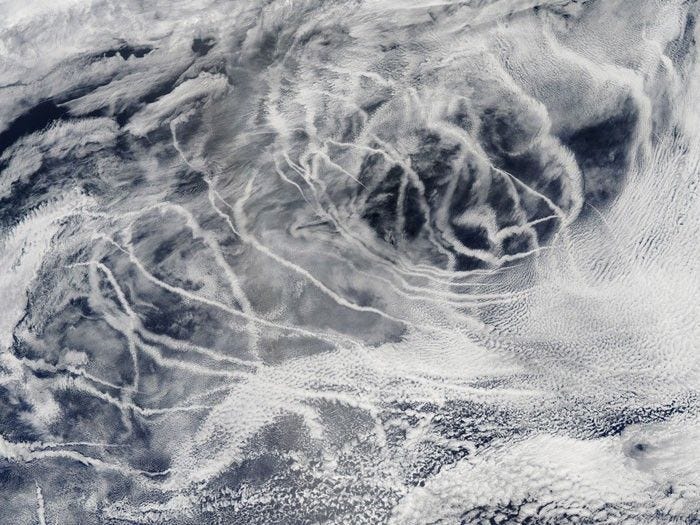
I take two things from this. First, humanity has been running an uncontrolled aerosol cooling program for decades and terminated a large piece of it abruptly, through an air-quality rule made with no climate deliberation and no plan for measuring what would follow, which means the ungoverned path is already a matter of historical record. Second, the event confirms that termination effects are physically real, and that is the argument for treating termination as a design constraint rather than a verdict. Andy Parker and Peter Irvine worked through the failure pathways back in 2018 and concluded that a deliberate program built with backup deployment hardware and operated by agreement among several capable states would be resilient against all but the most extreme catastrophes, because sustaining a termination shock requires every capable actor on Earth to stop, simultaneously, for years, while temperatures climb around them and each has an overwhelming incentive to restart. Termination risk is a reason to engineer and govern deployment carefully, and a strange reason to know less about the system we would be governing.
The march is underway
Ted writes as though stopping the research would stop the march toward deployment. The companies he links to are evidence against that. He cites Stardust, the Israeli-American startup that raised 60 million dollars last October, the largest known funding round in the field’s history, with a business model of selling deployment capability to national governments and outdoor experiments already planned. Stardust took heavy criticism early on for keeping its particle chemistry secret, and in May it started publishing: white papers and preprints with university collaborators, disclosing particles built from amorphous silica and calcium carbonate. People I talk to in the research community were glad to see it, and I was too, though the safety questions are far from settled. Make Sunsets, meanwhile, has been lofting balloons and selling cooling credits for years and recently made its patent available royalty-free. Whatever you think of these companies, the capability is being built regardless of what academic researchers and their funders decide. And notice what pushed Stardust toward openness: a research community that existed to demand it and scientific norms that gave it something to publish into, which is the infrastructure Ted proposes to strip away.
So run his scenario forward under his own proposal. Suppose the research stops: the university programs wind down, the philanthropy dries up, the monitoring and attribution science never matures, the governance conversations never happen. The political incentives he describes remain, and so do the startups. The next accidental climate jolt arrives with no one equipped to measure it. If you wanted to guarantee the outcome Ted fears—deployment arriving through commercial secrecy or political panic with no public science and no institution capable of stopping or steering it—this is how you would arrange the world. Opposing research is a recipe for the exact worst outcome he believes might happen. The choice in front of us has never included a world where nobody builds this. The choice is between preparing in a way that mitigates the risks as much as possible and just allowing it to happen.
The position the horseshoe can’t see
The most interesting claim in the essay is sociological: that advocates and opponents of geoengineering have converged on identical, catastrophist views of climate risk, distinguishable only by the solution attached. There are people who fit that description. But the taxonomy has a hole in it, and I know because I live there.
I spent a decade on the other side of this problem. I co-founded Nori, one of the first carbon removal marketplaces, and spent years convincing investors and researchers and policymakers that removing carbon dioxide from the atmosphere was necessary and possible. I believed we could scale our way out. What changed my mind was the arithmetic: carbon removal is decades away from moving global temperature, the tipping-point risks arrive on a faster clock, and the gap between those two timelines has to be covered by something. I am not a catastrophist about the present. I don’t believe we need to overhaul the global economy to respond to climate change, and I came to this work through market-based solutions. Ted’s horseshoe has no place for that position, and a growing part of this field lives in it.
His use of the word geoengineering deserves a look too, because in the essay it means one thing: global stratospheric aerosol injection, with its globe-spanning politics and its worst-case termination profile. Most of the intervention portfolio looks nothing like that. Marine cloud brightening is regional, and its clouds stop responding within days of stopping. Proposed interventions to slow ice sheet loss are anchored to particular glaciers and can be removed. Ted knows the difference, because the MCB program he proposed in 2024 to moderate the El Niño cycle was (even offered half in jest as he says it was) a bounded, regional intervention whose logic depends on the distinction his new essay erases. The question his essay never answers is what separates the intervention he proposed from the ones he now opposes. The way I hold the whole picture now: mitigation and carbon removal address the causes of the problem, adaptation shores up the human systems that absorb the consequences, and stabilization protects the climate systems that both of the others need time to work. Naming the pillar for its outcome also sets the standard it has to be judged against, something the word geoengineering never did.
Where does that leave the disagreement? Ted’s real question, underneath the essay, is whether a world this bad at telling real emergencies from manufactured ones can be trusted with a lever this large. That is a good question. It is also a governance research question, and governance research is part of what he is proposing to stop. The monsoon impacts, the termination pathways, the attribution science, the institutional designs that could make starting and stopping legitimate: these are the research agenda, and the people working on them are, in my experience, more sober about the risks than either pole of his horseshoe. He is asking one of the right questions, and I would welcome the exchange, because this field is better off with its sharpest critics inside the conversation. Readers who want to see what the field contains before picking a side can start with my standing guide, How to Learn Everything You Need to Know About Climate Cooling.
Ted's governance concerns deserve serious attention, but the argument remains too asymmetrical.
Ted treats continued climate warming as broadly manageable through adaptation, while evaluating solar climate intervention through the most extreme imaginable scenario: large-scale deployment, decades of dependence, institutional failure and abrupt global termination. That is not a balanced comparison of risks.
It also ignores the escalating costs of doing nothing—or doing too little.
Inaction is not a neutral baseline. It means accepting rising expenditure on heat-related illness, crop losses, water scarcity, wildfire, flood protection, coastal retreat, infrastructure damage, insurance withdrawal, ecosystem collapse, disaster relief and displacement. These costs accumulate year after year, while losses to nature, public health and social stability are often irreversible or never fully reflected in financial accounts.
The relevant comparison is therefore not between a risky intervention and a cost-free natural world. It is between different intervention pathways in a climate system that humanity has already altered.
“Termination shock” is also too often presented as though it were an inherent property of every cooling intervention. It is not. It is a specific failure scenario in which substantial greenhouse warming is masked for a prolonged period and the cooling influence is then stopped suddenly, without phase-out, replacement capacity, carbon removal or sufficient emissions reduction.
The warming revealed after termination is not created by the intervention. It comes from the greenhouse gases already accumulated in the atmosphere. A more accurate term would be rapid rebound warming following abrupt withdrawal of large-scale climate masking.
This distinction is especially important for marine cloud brightening. MCB could potentially be modular, regional, seasonal, adjustable and based on short-lived sea-salt particles. A bounded or regional intervention cannot logically produce a massive global termination event, because the rebound cannot exceed the cooling influence being withdrawn.
Humanity is also already experiencing warming unmasking as harmful aerosol pollution is reduced and part of its accidental cloud-cooling effect disappears. Cleaning the air is essential, but the loss of that cooling influence is physically real. It is inconsistent to accept the disappearance of accidental cloud cooling while rejecting research into whether a cleaner, controlled and reversible marine influence could temporarily reduce climate risk.
None of this proves that MCB or other forms of solar climate intervention are safe. Cloud responses, precipitation, regional circulation, ecological effects, governance and justice all require rigorous study.
But uncertainty cuts both ways.
There are uncertainties around intervention, but also profound uncertainties around unchecked warming, tipping points, compounding disasters and the capacity of institutions, insurers and public budgets to absorb mounting losses. Treating the risks of intervention as unacceptable while discounting the much larger cumulative risks and costs of non-intervention is not precaution. It is selective risk accounting.
The real choice is not geoengineering versus decarbonisation. A credible stabilisation strategy requires emissions reduction, carbon removal, adaptation, ecosystem and ocean restoration, and careful research into reversible methods of reducing excess planetary heating.
Research is not deployment. A controlled experiment is not a permanent planetary commitment.
The greater danger may be allowing climate damage and its associated economic, ecological and human costs to grow beyond society’s capacity to manage them, while refusing to investigate tools that could reduce those losses.
The burden of proof should therefore apply not only to intervention, but also to those advocating continued delay. They must explain why the risks and costs of inaction—which may far exceed the costs of responsible climate action and carefully governed intervention—should be accepted.
Well done.