
What We Mean by Stabilization

This is part two of a pair of articles. Part one shared the observations report that Ben Lachman and I wrote after interviewing 29 organizations working in this space. This piece considers the word “stabilization” itself, which drew more feedback than anything else. And if you would rather debate it in person, the Global Risk and Stabilization Summit is in Iceland, October 12 and 13 (globalstabilization.org).
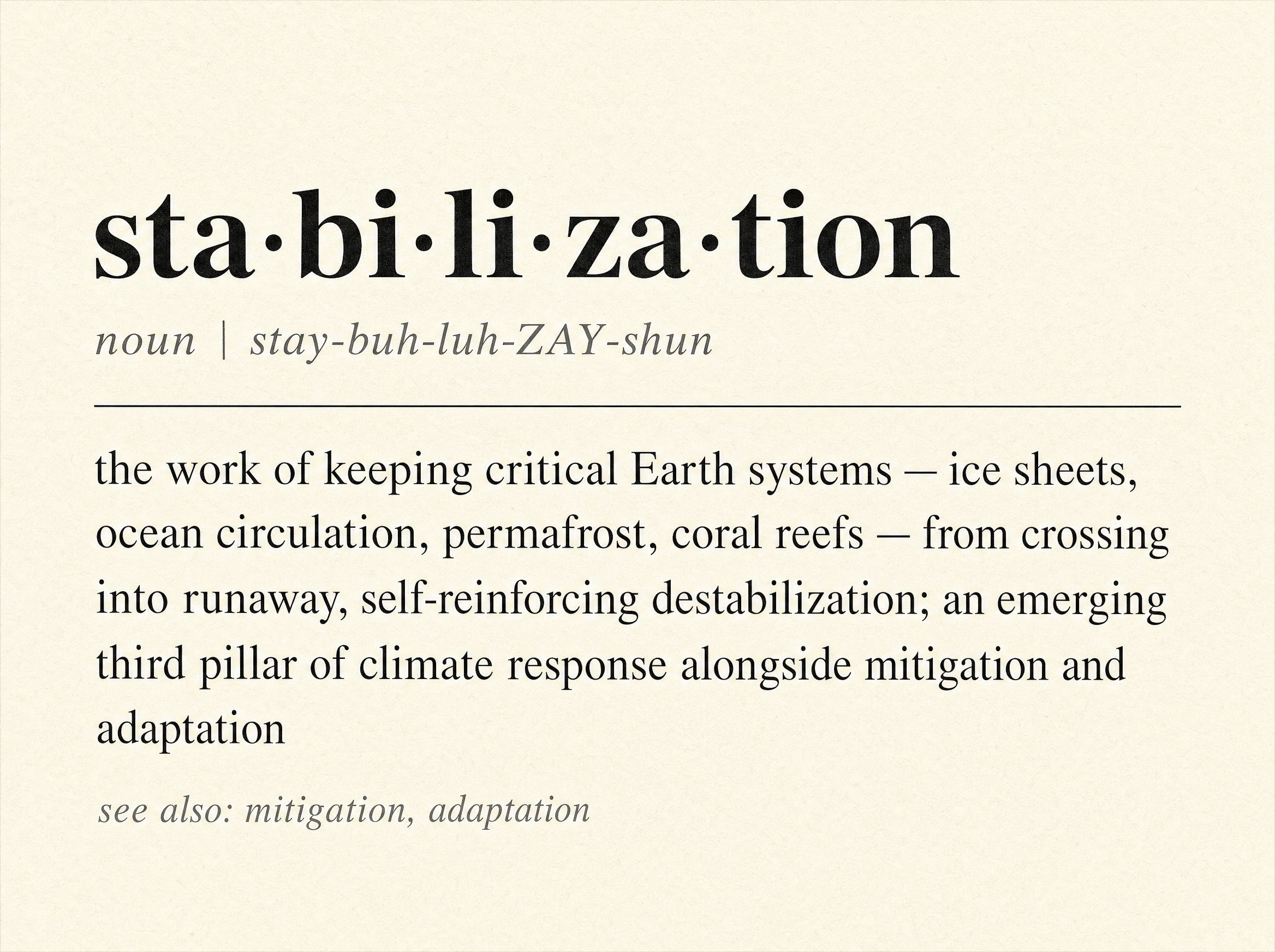
Stabilization is a term I thought I was making up. I started suggesting it last fall because I wanted a way to talk about this work that could move past geoengineering, and I think about naming more than most people in climate do because I spent ten years doing category creation in carbon removal (CDR). I was just a guy proposing a word, and I proposed it to solve some specific problems.
My intent with this article is to do two things:
Steelman the arguments we’ve heard against the term
Clarify a more specific definition of stabilization and invite further discussion, refinement, and improvement
Here are the parameters Ben and I discussed (starting last fall) as we developed the “Stabilization Plan” concept and the term that came from it:
If important Earth systems destabilize to the point of impairing the ability of governments and markets to respond to the root causes of climate change at all, then we are in serious future danger. We simply must find ways to avoid this outcome.
To avoid it, the field needs to grow, which means more philanthropic funding and more people coming to the space. Only a few foundations have been willing to fund research, and most of that goes to SAI. This leaves other stabilizing interventions severely underfunded, all from the same small set of funders we came to call “the usual suspects.”
Everyone (even the interconnected usual suspects) refers to these interventions differently, so the field is fragmented in how it organizes, funds, researches, and acts on any of them.
The fragmentation happens in part because “geoengineering” is a poisoned word that has come to mean many things, and it carries an innate hubris that turns many people off. “Climate engineering” carries most of the same turnoffs.
To have the potential for success, this work should eventually be funded and carried out by nation states, which means politicians need to be able to talk about it in a way that garners support from their constituents.
Emergency framing is a nonstarter.
“Climate interventions” covers what many of these things are, but it is unlikely to galvanize anyone beyond the most involved researchers or practitioners. As a field name it sounds dangerous and risky. It’s not “for” something the way “renewable energy” or “carbon removal” or even “adaptation” are “for” solutions. It doesn’t describe a desired end state or set a goal. It doesn’t invite people to join the field and contribute. It’s not aspiring or inspiring.
The esteemed systems expert Donella Meadows wrote that her number two most effective way to intervene in a system is to change “The mindset or paradigm out of which the system — its goals, power structure, rules, its culture — arises.” From Meadows:
So how do you change paradigms? Thomas Kuhn, who wrote the seminal book about the great paradigm shifts of science, has a lot to say about that. In a nutshell, you keep pointing at the anomalies and failures in the old paradigm, you keep coming yourself, and loudly and with assurance from the new one, you insert people with the new paradigm in places of public visibility and power. You don’t waste time with reactionaries; rather you work with active change agents and with the vast middle ground of people who are open-minded.
So last fall I suggested we needed a new paradigm for thinking about these activities. I proposed that the thing we all want is stability, because stability is a necessary precondition for finishing the job of decarbonization and legacy carbon removal, which will take decades if not centuries. To those of us who have adopted the term, stabilization feels like it could be the new paradigm that helps set the “goals, power structure, rules, and culture” for striving to prevent Earth systems from destabilizing further, and the many systems downstream of them from following. I took her advice, pointed at the anomalies, and wrote a bunch of articles about it.
And the word spread further than I expected! Several groups working in this space converged on it as shared language, papers have mentioned it, we co-hosted an event in San Francisco built around it, at least two organizations (that I know of) rebranded to include Stabilization in their names, and the Global Risk and Stabilization Summit convenes in Iceland this October.
It turns out I wasn’t making it up, though. Stabilization carries a long history in climate circles, which I didn’t know when I started using it and have since learned. As more people adopted the framing, we started hearing objections from scientists, researchers, and policy folks we interacted and shared the report with. Many of these objections have changed how we use it. Other points we disagree with, and I’ll explain why. All of it is good, however, because it forces us all to discuss more directly the underlying problems we’re trying to solve together.
Most of what’s below is a composite of feedback from interviews, report responses, and calls, left unattributed since we promised interview participants confidentiality. The exception is Holly Buck, who published her opinion last week, and I respond to her thoughts directly further down.
Our initial framing on stabilization
Stabilization is work that attempts to intervene directly in Earth systems destabilized by climate change that are at risk of runaway or self-reinforcing outcomes. This is done to buy the time now required to complete implementation of slower, more permanent climate solutions.
Nobody trying to shade coral reefs by brightening clouds is purporting to stabilize the entire climate. Neither is someone who attempts to refreeze Arctic sea ice. In both cases, they are acting on systems that, if their destabilization proceeds unabated, will threaten the stability of other systems as well—from human systems like food production to ecosystems and weather. The object of a stabilization intervention is an Earth system, and the beneficiary is every system downstream of it.
An analogy we (meaning Ben and I) use frequently comes from healthcare. When a trauma team stabilizes a patient, nobody in the room believes the patient has been cured; stabilizing is the interstitial step that keeps additional treatment possible. In the same way, stabilization measures are meant to be temporary, wound down as emissions cuts and carbon removal bring the climate back toward safety.
This is also why we’ve been moving toward using stabilization by itself rather than prepending it with climate. What we’re trying to stabilize is a set of Earth systems. Calling it climate stabilization has led some people to see an all-encompassing term for all parts of climate response, while we see a need to create space alongside mitigation and adaptation.
The third pillar
The two established pillars of climate change response, reflected in the IPCC’s working group structure, are mitigation and adaptation. When we say mitigation, we mean managing the stocks and flows of greenhouse gases, cutting new emissions (decarbonization) and drawing down legacy ones (carbon dioxide removal). This is a paraphrase of the IPCC, which defines mitigation as “a human intervention to reduce emissions or enhance the sinks of greenhouse gases”.
Adaptation absorbs consequences of climate change in human systems, e.g. with seawalls and heat plans and changed agricultural practices; in the IPCC’s words, it is “the process of adjustment to actual or expected climate and its effects” so as to lessen harm.
Stabilization acts on destabilizing Earth systems directly. These three pillars sort the work clearly. Halting deforestation or sequestering carbon in biochar both influence carbon stocks/flows, so they go with mitigation. Building seawalls or planting species of crops that tolerate heat better are clearly adaptation measures. Preserving an ice sheet doesn’t target greenhouse gas concentrations, so it is clearly not mitigation, and as I wrote in What’s the Difference Between Adaptation and Geoengineering?, it is also quite different from adaptation. Where, then, should it go? Our proposed answer is stabilization.
The IPCC glossary does have a stabilization entry, and while this isn’t commonly used today, it means something different: a state where the atmospheric concentration of greenhouse gases holds constant over time. That is mitigation’s finish line—an end state rather than a pillar of work. I address this collision between the older sense of the word and ours in the objections below.
Adding a pillar has happened before. Adaptation was not always considered a reasonable and important aspect of climate change response. Ian Burton, the geographer who did more than anyone to push adaptation onto the climate agenda from the first international climate meetings onward, spent years being told by mitigation’s most fervent advocates that even talking about adaptation was counterproductive. If we could just focus on mitigation, then adaptation wouldn’t be necessary. Here’s Al Gore in 1989:
The advice to adapt rather than prevent these [climate] changes is unwise counsel. The changes are occurring so rapidly that adaptation will not be possible without major disruptions in our civilization. The advice to adapt is an obstacle to the correct political response, which is prevention.
Burton’s answer was that both would be needed, because you “wouldn’t be able to mitigate fast enough” to escape adapting. He kept at it until the IPCC gave adaptation a working group home in the mid-1990s, and in 2021 he shared a Frontiers of Knowledge Award for the paradigm shift. He spent years doing what Meadows describes, pointing at the anomalies until the paradigm moved.
So why does stabilization need a pillar at all? The answer is the one Burton gave in the 1990s, except now we have even more data. Atmospheric CO2 reached 427 ppm in 2025. We emit around 40 billion tonnes of CO2 every year (with no sign of that going down), and the entire carbon removal industry has durably removed about one and a half million tonnes, cumulatively, ever. Even the most optimistic scaling scenarios put cumulative removal by 2050 at roughly 100 billion tonnes, which works out to only two or three years of current emissions. And CO2 does not clean itself up on any timescale that helps us. A large share of every tonne we emit stays in the atmosphere for centuries, so ending all emissions tomorrow would only stop the problem from growing without shrinking it. The Earth systems at risk will keep responding to the heat already locked in while we spend decades (potentially centuries!) scaling carbon removal. Burton said we wouldn’t mitigate fast enough to escape adapting. The numbers today say we won’t mitigate or remove fast enough to escape stabilizing.
The objections
This is just geoengineering with a new coat of paint.
I said at the top that I wanted to move past geoengineering, and so have many others, so the suspicion of a “rebrand” is fair. We argue that the renaming is necessary to change the conditions preventing the field from growing. “Geoengineering” and “Stabilization” point in different directions. Geoengineering is solutions-first. It names a set of technologies and leads with what we could do to the planet, and one of the clearest findings from our interviews was that solution-first framing turns people away while risk-first framing brings them along. Stabilization is risk-first. It names the state we want, and the only reason to pursue it is that specific Earth systems are being destabilized. The actions stay what they are—call them climate interventions or Earth-system interventions or stabilizing interventions—undertaken in service of the goal and only when justified by the risk. The contents of the term has also changed. The original geoengineering definition bundled in carbon removal, while stabilization leaves CDR as part of mitigation and includes work nobody calls geoengineering, like Arctic rewilding or localized reef cooling. In our Building Permission Space report, we made the case that this renaming is intentional and useful for the field’s goals.
Stabilization already means something else.
It does, and this was the objection we heard most from people close to the UNFCCC/IPCC processes. The Framework Convention’s stated objective is to stabilize greenhouse gas concentrations at a safe level, so for more than thirty years “climate stabilization” has meant managing concentrations, or holding temperature at a target, or sometimes just solving climate change in general. The general take has been something like: the whole climate era began as a stabilization project, so why reach for a word the field already used up? Our response is that as we define it, stabilization is neither the stabilization of concentrations, which is mitigation’s objective, nor a fixed temperature target. The objects are particular Earth systems. And it is a very useful word that accurately describes the attempted work of this field. Our shift away from climate stabilization and toward stabilization alone attempts to integrate this feedback.
If you’re going to use it, make it the umbrella.
Some people flipped the objection around and suggested the opposite, keeping the word but making it the overarching category, a stabilization that contains mitigation and adaptation along with anything else as the means, since the point of every climate response is a stable Earth. I understand the logic, but believe the strategy is backwards. Asking the entire climate world to reorganize its language under a term we floated a year ago would be both naive and ill-advised. But adding stabilization alongside the existing pillars asks nothing of anyone except consideration and tolerance. A new umbrella also wouldn’t help create what this field needs. Large climate philanthropies and government policy agendas allocate resources to line items for mitigation, for adaptation or resilience, sometimes for carbon removal and superpollutant destruction, and whatever remains to a scattering of uncategorized projects around the edges. A new umbrella over the whole table restructures their work without creating the line item that so many uncategorized and underfunded research efforts sorely need.
Can you stabilize a system while the planet keeps warming?
Yes, partially, and partial is already how the second pillar works. If warming is the destabilizing force and warming continues, then stabilizing anything is incomplete by definition. The same is true of adaptation, which is by definition something we do while the Earth keeps warming; a sea wall does not stop the sea from rising, and nobody concludes that adaptation is incoherent. Stabilization operates the same way, by attempting to hold specific systems stable, as long as required, with success measured against the system’s existing trajectory rather than the planet’s temperature.
It over-promises.
Stabilization names an outcome, and this objection is correct that the name doesn’t answer whether the outcome is deliverable. We know a lot about the coupling between cutting emissions and atmospheric concentrations. We know much less about the coupling between attempting to stabilize an ice sheet and the prevention of ice sheet collapse. Additionally, any proposed stabilizing intervention could act and fail, or worse, act and cause new harm. This objection would state that a humbler word like interventions is safer because it promises nothing beyond the action, and whoever intervenes still has to make the case that it will work.
That asymmetry is real, and it’s precisely why the field needs more funding: funding for people studying the potential risks of interventions, funding for people developing governance mechanisms around deploying them, and funding for people developing new or alternative interventions so that we have options when some interventions turn out to be harmful. But mitigation and adaptation also name outcomes we haven’t finished delivering. Both are partially done and pointed in a generally good direction, neither is moving fast enough, and the global conversation about each is whether we’re delivering. Nobody reads those words as guarantees. A pillar’s name states the intention the work gets organized around and judged against.
Ben put it more simply on one of our calls: nobody aspires to intervene. Intervening is a cost, a thing you would rather not have to do, while stability is what people want, and a field should be named for what it is for. The outcome-name also does something useful for these technologies that carry the most hubris risk. A field named stabilization hands the world the standard to judge it by, because for any proposed intervention the question becomes whether the system is measurably more stable, on what evidence, and at what cost. A field named for its activity can “succeed” just by being busy. I would rather have a name that makes it easier to understand what success means.
Science needs rigor, and this term doesn’t have it yet.
Correct. The term is ambiguous partly because this usage is new. Scientists parse every word, want rigorous definitions, and have watched loose terminology cause damage in this field before. Stabilization is not yet a rigorously defined scientific term, and the definition below is a field-building definition, proposed to satisfy the parameters at the beginning of this article—where politicians, funders, and newcomers were the constraints—rather than built to survive peer review. Those audiences pull in different directions than science, and right now this objection is valid, as there is no real scientific rigor around it. What I’d ask of scientist readers is participation. Our own usage has already changed in response to feedback. The move away from the climate modifier came from these conversations, and the pillar framing in this piece is itself a second or third iteration. Our hope is that the word earns rigor the way words do, by entering scientific and academic discussion and getting argued over. We started this discussion around stabilization, but we don’t claim to own the word.
The public case against the word
Last week Holly Buck published the fullest public version of the case against the term, Selling Stability: The Problem with Pitching “Climate Stabilization” as a New Category of Climate Response, at African Tech Futures Lab. Holly has studied geoengineering and its politics for the better part of two decades and wrote After Geoengineering (which I loved, and you should read), and I learn something from her writing every time. She made her case in public, so I’ll respond to it the same way.
By my reading, we agree on many underlying premises. The tipping-element risks are real and potentially urgent and severe, a reflexive loop in which climate change erodes our capacity to respond to climate change is a real risk, the research landscape for response measures is broken, and a container for these interventions would help people think about them and would probably motivate additional research funding. The remaining disagreement seems to me to be over whether this container, with this name, costs more than it delivers. Her history section also complicates the prior-usage objection by identifying that the earliest use of climate stabilization in the scientific literature, a 1974 paper in Science, meant climate control and intervention, and she describes today’s usage as the term coming full circle.
Two of her arguments moved me. The first is about baselines:
Stabilization elides questions about whose baseline is being stabilized—and whose is being destabilized by stabilization itself. This is the same question that was asked in 1974, though from many more voices. For much of the majority of the world, things have not been stable at all. Indeed, for communities who have lived through colonialism, extraction, and displacement, “stability” was rarely on offer to begin with. Stabilization language casts political acts in terms of neutral systems maintenance, obscuring whose reality and power is actually being protected.
I partly agree. The objects in our definition are physical systems, and the destabilization of those particular systems lands first and hardest on the people for whom stability was never on offer. A disrupted Atlantic circulation would impact monsoons and agriculture, collapsing coral reefs would impact local food systems, and sea level rise will reach every low-lying coast on Earth. That is an argument about who has the most at stake. It is not an argument about what anyone wants, and we don’t pretend the two are the same. High stakes don’t produce consent. Deciding which systems get stabilized, at what baseline, and for whose benefit is the rightful job of politics. Our field definition refuses to presuppose which systems ought to be stabilized or what a stable future should look like, and Holly’s critique clearly shows why those questions deserve real deliberation. We are explicitly not trying to hide political choices behind a fig leaf of technology or technical descriptions. All of that social legitimacy and governance work can and should fit within the pillar.
The second is about what the word implies.
Stabilization presents an inaccurate picture of what is actually happening to the planet. Solar radiation modification is likely to stabilize global mean temperature, but create novel biospheric conditions, because the amount and type of sunlight is being changed and CO2 emissions would be decoupled from temperature. This would be a new situation for ecosystems, in ways that have not been seriously researched. As a recent piece by ATFL’s Climate Intervention Futures Initiative noted, stabilization describes an aspiration, not a guarantee. Stabilizing temperatures is not the same thing as holding the climate steady. Ultimately, it’s the planet itself that does the stabilizing.
I agree without reservation. Her line about it being an aspiration rather than guarantee is close to how I’d describe all three pillars. The medical sense of the word carries some of this already, since a stabilized patient is not a healed one. This is an example of where a critique pushed us to improve the clarity of the definition, and the definition below now says clearly that a stabilized system is not a restored one.
Where I disagree with the article is her conclusion that the container problem dissolves if we just call things what they are. She asks where the desire to taxonomize comes from, notes that a name changes none of the work, and asks who the sales pitch is for. They are fair questions, but they fold two things together, because the need for a class term exists before anyone tries to “sell” anything.
The first reason for the term is pragmatic. The potential interventions are so varied that on the surface they almost seem unrelated. What do wildfire management policy that keeps abrupt permafrost thaw in check, reflective coverings on glaciers, marine cloud brightening over reefs, cirrus cloud thinning, sea ice thickening, and stratospheric aerosols all have in common? Anyone who needs to discuss the class as a class, in a research agenda or a governance framework or a funder’s memo, either recites that list or borrows a word that fails somewhere, because geoengineering doesn’t fit the wildfire policy, cloud thinning is not sunlight reflection, and none of it is mitigation or adaptation. The nearest candidate is “climate interventions”, and we use it ourselves for naming the actions. But the field is more than its actions. The field includes the monitoring that tells us whether a system is approaching a threshold and it includes the governance work that decides whether anyone should act. None of that is “intervening”. And part of the field’s job is deciding whether to act at all, so naming the whole field for the act would prejudge the very question the governance work exists to ask. The definition below says we don’t presuppose that intervening is the right answer, and the field’s name shouldn’t presuppose it either. An umbrella term is useful when people keep needing to refer to a class of work the existing words don’t cover, and that need would exist even if nobody were trying to grow the field.
The second reason is the one the parameters at the top of this piece state outright. We see the need far more money and many more people in this work, and names and aspirations are, in part, how that happens. Right now one foundation might file this work under climate interventions, another under tipping point risks, another under extreme adaptation, and most file it nowhere at all, which is the fragmentation problem seen from a funder’s perspective. A single coherent term reduces that friction, and it gives the entrepreneurs and researchers who aren’t here yet a field they can find. A program doing marine cloud brightening can and should keep saying MCB, plainly; the umbrella term is for talking about the class and for growing it. A name doesn’t change any of the work to be done, but it does change who shows up to contribute to the work.
Holly raises more than I can take up here, on agency and on what the frame leaves out, and I hope you read her piece in full. I believe we agree on the deepest point, that the work matters more than the taxonomy, and the taxonomy is only worth arguing about because it affects how fast the work gets people and money. And ultimately, this term is a proposal, not dogma. If the field finds it useful, we’ll see it get adopted more widely. And if the field doesn’t, then we’ll all collectively figure something else out.
The definition, as it stands
Here is the full definition as we are now using it, revised by everything above. It will keep changing, and the feedback form in the observations report is the best channel for changing it.
Stabilization is the work of keeping critical Earth systems from crossing into runaway, self-reinforcing destabilization, the kind that could foreclose our collective capacity to respond to climate change at all. It is an emerging pillar of climate response that sits alongside mitigation and adaptation. Mitigation, which includes carbon removal, addresses the cause by reducing and drawing down greenhouse gases. Adaptation absorbs the consequences in human systems reducing harm. Stabilization, if it is feasible and desirable, intervenes directly in the Earth systems most at risk of nonlinear, possibly irreversible change, to buy the time that mitigation requires.
This is not the stabilization of greenhouse gas concentrations, and it is not holding global temperature at a fixed target. Those are objectives served by mitigation and removal. Stabilization is a near-term response to a risk profile that has developed faster than we have implemented mitigation efforts. Possible tipping elements including the Greenland and West Antarctic ice sheets, the Atlantic overturning circulation, permafrost, and warm-water coral systems are approaching limits on timescales that decarbonization and carbon removal simply cannot address in time.
Stabilization measures are meant to be temporary, wound down as mitigation and removal bring the climate back to safety. We are honest that the warming already committed to the system through past emissions means that some measures may need to hold for decades or longer. They remain a bridge, not a destination. A stabilized system is not a restored one. Interventions that keep a threshold from being crossed still leave the planet in a changed state, and what it means for ecosystems to hold in novel conditions is an area this field must research.
When we call stabilization a field, we mean something specific and modest. A field is a loose-knit body of people working across many disciplines, from climate science and engineering to finance, governance, and frontline engagement, in pursuit of a shared set of goals. It is not an organization, it has no central authority, and it does not speak with one voice. We are not declaring a field into existence. Much of this work is decades old, carried on by researchers and governance experts through years when pursuing it cost people funding and reputation. What we are observing is a field that is beginning to cohere. We can see this in the new research, new funding, and new initiatives emerging across these areas, and we are naming it so the people doing the work can find each other. Some of them will disagree about the name, and reasonable disagreement among contributors is a feature of a healthy field rather than a flaw in it. Even so, we assert that the moment has come for this work to organize and grow.
Avoiding catastrophic, irreversible destabilization is worth preparing to act on now, before the conditions for a considered response are gone. That commitment is to building tools and preserving options, not to deploying them. We do not assume that intervention is the right answer in any specific case. Nor do we presuppose which systems ought to be stabilized, or what a stable future should ultimately look like. Those are the scientific, governance, and legitimacy questions this work exists to consider. What we assert is narrower: building the capacity to choose well, in time, beats being forced to choose without it.
I believe stabilization is the right name, and none of the feedback has felt like a deal-breaker. It has felt like people pointing out where the term is unclear and could become clearer, and to me that means the process is working. Meadows wrote that paradigms change when people point at the anomalies of the old one and speak, with assurance, from the new one. That is what this piece has tried to do. And, helpfully, the critics were doing the same thing to us. They pointed at our anomalies, and the definition above is better for it. Perhaps Earth-system stabilization is a better term than climate stabilization. Or perhaps it’s better on its own as just stabilization. The formal definition should end up written by many more hands than ours. If the name helps you explain your work, use it. If it gets in your way, tell me how, because the definition is only going to improve by people pushing back on it.
There is a lot to unpack here - and some of this will take time. But in the meantime, I just wanted to thank you Paul for this. Whether I agree with everything you wrote or not is one thing - and I will come back on those issues. But it is precisely these kinds of conversations that we need at this time. Words have consequences, so we have to be clear…