
Stabilization Needs a State That Works

tl;dr Every big climate intervention we will one day need assumes governments are capable enough to fund it, run it, and agree on it across borders. That capability is eroding right now, and this field has to watch it as closely as it watches the science.

Every plan to cool the climate or hold an ice sheet together counts on capable governments to pay for the work and run it, and enough cooperation between them to act together. That’s a bigger assumption than it looks, and right now it’s coming apart.
Start with the trust between governments. In January, Mark Carney told the World Economic Forum that the international order is in a rupture, not a transition, and he named the institutions he sees under threat: the World Trade Organization, the United Nations, and the COP—the climate negotiations themselves. Carney ran two central banks before he became Canada’s prime minister, so he isn’t a man given to drama. You can see what he means in how this year’s two big wars are being handled. The US and Israeli war on Iran that resulted in the shutdown of the Strait of Hormuz, and Russia’s grinding war on Ukraine, are being managed, to the extent they’re managed at all, by leaders cutting private deals with each other rather than through any institution built for the job. Trump ended the Iran war over dinner with Macron. The talks his team have been brokering on Ukraine have gone nowhere. Either way, the shared machinery for handling big problems is being bypassed in real time. It’s the era of “the art of the deal.”
Now look at the governments themselves. Just this week we saw Keir Starmer forced out as British prime minister by his own party, the sixth British PM to go in seven years, with Nigel Farage’s Reform UK pushing for an early election. The populist churn behind that isn’t unique to Britain; it’s running through most of the democratic world. So just as more weight would fall on individual governments to act, those governments are less steady than they’ve been in a generation.
Put those two things side by side. The shared institutions are fraying, which pushes more onto individual governments, and those governments are wobbling like a glass vase during an earthquake. Both halves of what a climate intervention would need—capable governments and enough cooperation to act together—are eroding at once. That’s the world any serious plan to cool the planet now has to survive in.
If we want a field that can put serious money and real operations behind interventions in, say, ten years from now, the governments we’re counting on have to be capable ten years from now too, and that capability doesn’t build itself. Watching where the world is heading matters just as much as watching the science on tipping points and intervention options. Stabilization already has a lot of moving parts that people are working hard on: the research, the funding, the field itself, and the genuinely difficult job of running an intervention in the real world. State capacity is one more, and I think it’s the one we’re paying the least attention to.
What stabilization is
Stabilization, the way I use the word, is the near-term work of keeping critical Earth systems from tipping into runaway change, the kind that would wreck our ability to deal with climate change at all. (I’ve written about it at more length in The Climate Stabilization Framework.) Cutting emissions and removing carbon dioxide go after the cause. Adaptation deals with the damage. Stabilization does something else. It steps in directly to protect the systems most at risk of a sudden, irreversible tip: the ice sheets, the Atlantic overturning circulation, the permafrost, the coral reefs, the Amazon, etc. The point is to buy time for the slower tools to catch up, because if we don’t, then our society will be hit by famines, droughts, migration, populism, and more, things that society not only can't withstand but that would eliminate our ability to address climate change at the root.
Stabilization is meant to be temporary, with interventions safely wound down as cutting emissions and removing carbon bring the climate back toward safe temperatures. And it works directly on shared systems that no company can own or sell, which makes it the one part of the climate response you can’t build a market around. And even if you wanted to try, what’s the business case? You can sell carbon removal today (with a lot of difficulty) and it hasn’t come close to affecting the total amount of CO2 in the air. You can’t “sell” a stable ice sheet. So more than any other part of the climate response, stabilization depends on governments that work.
What a capable government needs
So what does state capacity actually mean? The plain version is whether a government can get done the things it’s supposed to get done. Some governments are good at it, plenty aren’t, and the worrying part, which Francis Fukuyama has written about for years, is that even rich, long-stable democracies can lose the knack over time. There’s a useful distinction, from the sociologist Michael Mann (funnily enough, not the climate scientist Michael Mann, who hates this stuff and said so again in the Guardian this month), between a government’s power to give orders and its power to actually carry them out on the ground. The second kind is what stabilization needs, and it’s the harder kind to build.
What the climate-scientist Mann and his co-authors argued, as it happens, makes my case for me. Their warning is that cooling schemes would be wildly expensive, and that once you start one you can’t stop without risking a sudden snap-back of all the warming you’d been holding off. They mean it as a reason not to try. It’s also a near-perfect description of why this would take a strong, steady government rather than a market. The best argument against doing it doubles as the argument for being able to. And that’s where the skeptics lose me. A dependency this big is a map of what we’d have to build, not a reason to walk away from it.
The way I usually get a handle on a problem like this is to start from the goal and work backwards. What are we actually trying to make possible? Then, what has to be true for that to happen, what are the pieces, is there an order to them, what does each one depend on, and so on until you can see what has to get done now. So: the goal is to be able to carry out a stabilization intervention well and responsibly when we need to (and from where I sit, I feel confident we’re going to need to). That means de-risking these enough that doing one is a real option rather than a desperate gamble. What would a government have to be able to do to get there?
I count six things, and they aren’t a checklist you work through top to bottom. Think of them as links in a chain of dependencies. Some are genuinely sequential, where one has to be in place before the next is even possible. Others build each other up at the same time. The reason the chain is the right picture anyway is that all six have to hold. A weak link stops everything that depends on it, however strong the rest are.
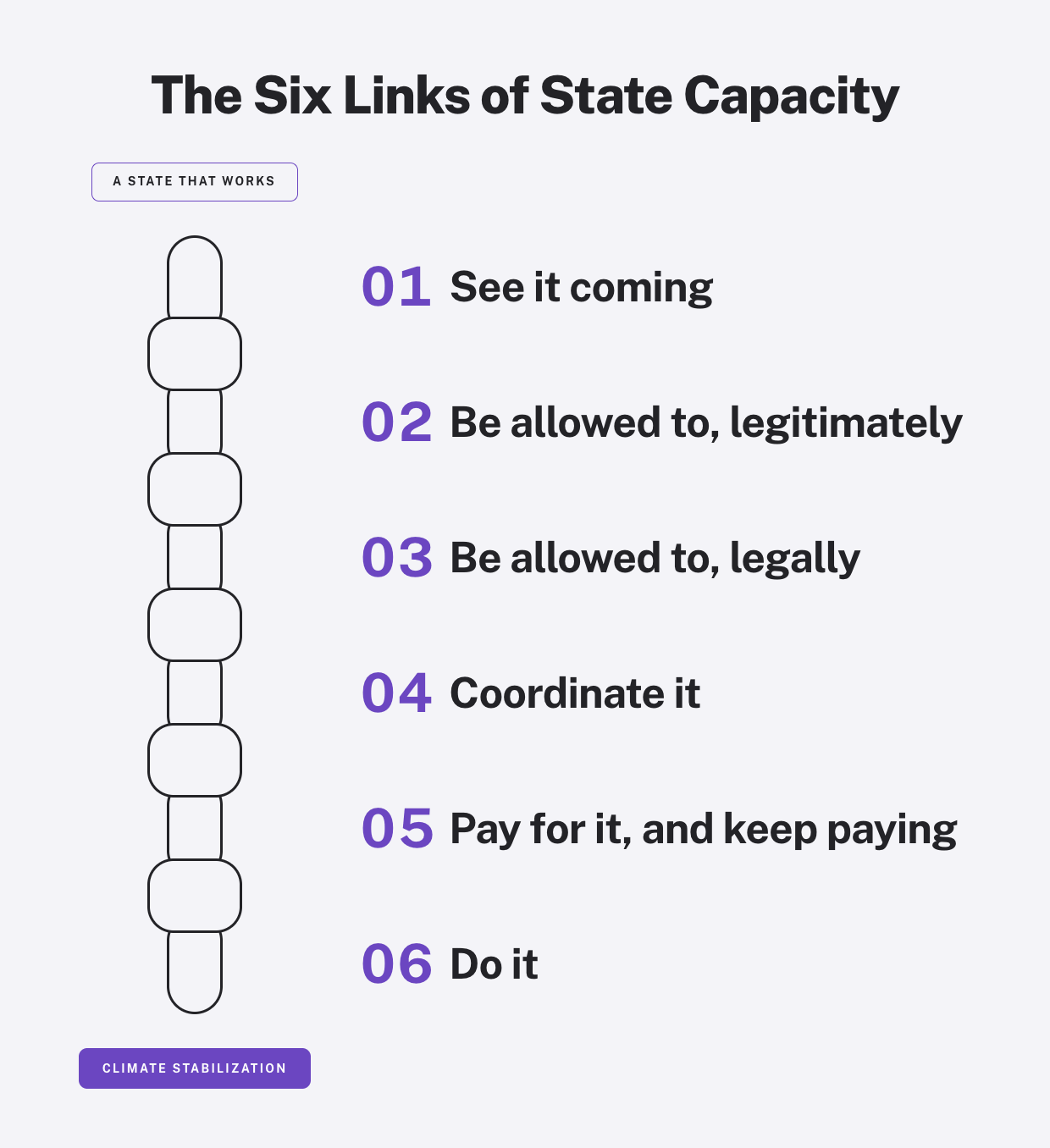
It starts with seeing the threat coming, which means setting up the monitoring and sensing to track these systems and understand what’s happening to them. Underneath even that is the most basic thing of all, the will to want to see the threat, which plenty of governments don’t have. The United States right now is choosing not to look. Nothing else on the list matters if a government won’t let itself notice the problem in the first place.
Before a government can do anything this big and this contested, it needs permission, and that comes in two forms, one deeper than the other. The deeper one is legitimacy: enough trust at home, and enough consent from other countries, that people actually accept the intervention instead of fighting it. It’s the slowest of the six to build and the easiest to lose, and for anything at planetary scale it has to come early, because nothing downstream gets authorized or funded without it. Up until now, I’ve been referring to this legitimacy as the “permission space” necessary to work on these things. The legal kind follows from the legitimacy, and it is the formal authority to permit the work, oversee it, and enforce the rules. That authority, or the lack of it, stops a small outdoor experiment far more often than money or science ever does, and it tends to follow public consent rather than lead it.
None of the cross-border parts of that—the shared consent and the authority that spans jurisdictions—hold together without coordination, both between agencies intra-government, as well as between governments (that might agree on very little). Coordination is the connective link running underneath the others, and it’s the one the current breakdown is fraying fastest.
Then there’s paying for it, and, just as important, continuing to pay. That’s a different thing from deciding to spend once, because stabilization will play out over decades while budgets run year to year and election to election. The hard part is going to be the second and the third and the tenth and the hundredth payment, many years after political movements enabled the first payment.
Only with all of that in place can a government actually do the work (or contract it out), which takes the people and the institutions to run something big and complicated for years on end. That muscle can’t be assumed. Anyone who watched California try and fail to build high-speed rail knows how hard it is for a capable, wealthy government to just build a thing.
Some of this is being built right now. The clearest example is the pay-for-it link in the United Kingdom. A government agency there called ARIA runs a research program on climate cooling worth around fifty-seven million pounds, the biggest pot of public money for this kind of work anywhere in the world. It’s also a good reminder of how fragile these links are. ARIA was set up by Boris Johnson’s Conservative government, which was three (soon to be four!) governments ago. The cooling money is committed, but whether the next government keeps funding a speculative cooling program, with budgets tight and politics turning, is anyone’s guess.
Other links are being torn down just as fast. This is most obvious in the United States, where the Trump administration has been pulling apart the climate spending in the Inflation Reduction Act and cutting climate programs, including some of the monitoring that the see-it-coming link depends on. Put it together and the picture is sobering. No government has anywhere close to all six links, though plenty have a strong one or two. None has the whole chain, and that will need to improve rapidly, because a strong funding link or a strong research link doesn’t add up to being ready on its own.
It’s getting built unevenly
That’s the sobering version. The hopeful version is that these links do get built, country by country, and how it happens is something we can actually learn from. It mostly comes down to framing. How a government describes a risk decides which part of the government wakes up to it, and that matters more than you’d think.
Let’s look at Iceland for an example of this. Late in 2025, its government became the first to officially treat a possible collapse of the Atlantic overturning circulation as a national security threat, not just an environmental one. That sounds like wordplay until you look at the effects of that. Calling AMOC a security threat sent it to Iceland’s National Security Council, the one body that can put every ministry in the same room at once. Suddenly the people who handle the country’s energy, food, transport, and infrastructure were planning around it together. If you frame it as an environmental issue, I have a hard time believing that any of that happens. I talked with Páll Gunnarsson of the Reykjavík Institute, who was close to all of this, about how a country of four hundred thousand people moved faster than far bigger ones. Some of that is particular to Iceland, where the Gulf Stream is common knowledge and the government is already built around hazard preparedness. But the lever, the part that could be duplicated by other states, was the framing: security, not environment.
Finland did a quieter version of the same thing. While it held the rotating presidency of the Nordic Council of Ministers, it pushed tipping points onto the agenda, and the result was a Nordic report on AMOC earlier this year that treats the risk as a governance problem for the whole North Atlantic. The response to this report is what I found interesting. The same science landed in front of several governments and got very different responses. Norway is still deciding whether to call AMOC a security risk. The UK noted the reports but figures a sudden collapse is unlikely this century, and Ireland briefed its prime minister and a parliamentary committee but has not taken it further. You could imagine tracking this properly, every country scored on all six links, so you could see at a glance who has actually built what.
The derailment risk
Now put the two halves together, the links being cut and the links being built, and you get a loop other people have already named. Laurie Laybourn and his colleagues call it the doom loop, or derailment risk: climate damage chips away at a society’s ability to deal with climate change, which lets the damage get worse, which chips away further, and around it goes. The same tipping points that would make us want to intervene are the ones that would wreck the funding and the institutions and the coordination we’d need to intervene at all. Stabilization needs state capacity, and state capacity needs stabilization. The crisis in the news is that loop running in real time. A world that can freeze its own energy markets in a couple of weeks, run through six UK prime ministers in seven years, and hear another one of its leaders (Carney) say the climate talks are part of an order that’s falling apart is a world quietly losing the ability to do the kind of slow, patient work that takes decades.
This is the part that changed my own mind. I got into climate work in 2015 believing markets could do most of the heavy lifting, and I still think that’s true for a lot of it, because markets are how we’re actually decarbonizing and how a lot of adaptation will get done. There will be companies and markets in stabilization too, which is something I’ll write about another time. But follow the logic of wanting stabilization to actually succeed, and you end up somewhere that this pro-market classical liberal/libertarian did not expect ten years ago. The specific things stabilization requires, the planet-scale interventions nobody can sell, can only be done by governments that work. Wanting those interventions means caring whether governments are capable, which is not how I used to think. There’s even a name for roughly where I’ve landed, state capacity libertarianism: what’s worth asking of a government is just that it actually be able to do what it sets out to do, whether that’s a lot or a little. Wanting a government that works is not a small thing to want anymore. It might be one of the most important things this whole field comes to want.
Which gets me to the one thing I’d ask of this field. We watch the science on these interventions closely, and the engineering, and we should watch the state of the world with the same attention, as a real input and not background noise. If you aren’t paying attention to where things are headed, you won’t be ready to plan, or argue, or act when it counts. I ended the framework piece by saying the goal is to build the ability to choose well, in time, instead of being forced to choose with no good options left. Here’s what I’d add. That ability was never only about the science or the technology. It’s about whether institutions and governments can actually function, and that capacity is eroding right in front of us. Helping build it, helping make those institutions capable and trusted enough to do this work, is part of the job too.
Hi Paul, this is a brilliant analysis of the reasons and risks around state failure on climate, thank you. Where I would add to your thinking is in the analysis of constituencies of support for sunlight reflection, as vital for the legitimacy, coordination and implementation links in the causal chain of the theory of change.
The key neglected theme in my view, as I articulate in my forthcoming book on Sunlight Reflection, is that major industries have a direct commercial interest in climate stabilisation.
Business leaders need to be targeted to convince them to fund a lobby group to create an Albedo Accord, which would be modelled on the Montreal Protocol as an alliance of science, government and business.
The Albedo Accord would serve as the governance secretariat for precisely the problems of government failure that you describe, moving rapidly to deployment of rebrightening technologies through effective advocacy, coordination and testing.
This is a paradigm shift from current climate approaches which are so statist and ponderous. Unlike the Paris Accord, an Albedo Accord will need to be explicitly pro-capitalist, accepting that carbon action will take longer than Paris assumed, working with the world economy rather than against it.
The market for rebrightening is similar to the market for sanitation, as a public good that is funded as essential infrastructure, building major new industries for deployment and MRV on a public private partnership basis.
There's a parallel to globalization, which (due to interlocking economic inter-dependence) probably did lead to greater prosperity and peace globally. A resilient governance framework that survives decades if not centuries will need the same qualities.