
How Do You Shift an Overton Window?
What marriage equality and AI safety can teach climate intervention advocates


After I published the Stabilization Framework series, my friend and former investor Rahul Shendure sent me a question worth sharing:
Are there other examples of activists explicitly embarking on a multi-year plan to shift an Overton Window for an issue with existential implications?
If you’re going to argue, as I have, that building cultural permission is the highest-leverage intervention point for climate interventions right now, you should be able to point to cases where that’s actually worked. I don’t just mean movements that succeeded through luck or historical accident, but campaigns where someone sat down, wrote out a multi-year strategy for making the unthinkable acceptable, and then executed it.
The answer to the question is yes, there are examples. But none of the precedents faced the exact combination of challenges we face, which means we’re adapting playbooks rather than following them.
The Gold Standard: Marriage Equality
In 1983, a Harvard Law student named Evan Wolfson wrote his third-year thesis arguing that same-sex couples had a constitutional right to marry. At the time, this was considered absurd not just by opponents, but also by most gay rights advocates, who thought the goal was too radical and would invite backlash. Wolfson laid out a multi-decade path to success anyway, and then spent the next thirty years executing it.
Freedom to Marry, the organization Wolfson founded in 2001, operated as a strategy shop: a central hub that continuously tested frames, disseminated messaging into litigation and campaigns, and coordinated the overall theory of change. Their “Roadmap to Victory” made the strategy explicit. The Roadmap laid a plan to win marriage in a critical mass of states, build national public support past majority levels, and then secure a Supreme Court resolution. They worked backward from an endpoint that seemed impossible and mapped the intermediate steps required to get there.
There are several key lessons to be drawn from this:
Make the destination explicit early. Wolfson argued for marriage itself, not civil unions or domestic partnerships, even when that seemed unrealistic. The theory was that aiming at the real goal would produce transformational rather than merely transactional change.
Lose forward. Early defeats were treated as opportunities rather than disasters. Each loss clarified messaging, built organizing capacity, and created precedents that could be leveraged later. Wolfson explicitly described this as part of the strategic arc.
Pivot the narrative. The early message framing emphasized rights, benefits, and legal equality. It wasn’t landing. So in 2010 the campaign shifted to an emphasis on shared values of love, commitment, family, and belonging. This reframe correlated with a sharp shift in public opinion and more favorable media coverage. The lesson is that leading with what you deserve is less persuasive than leading with what you share.
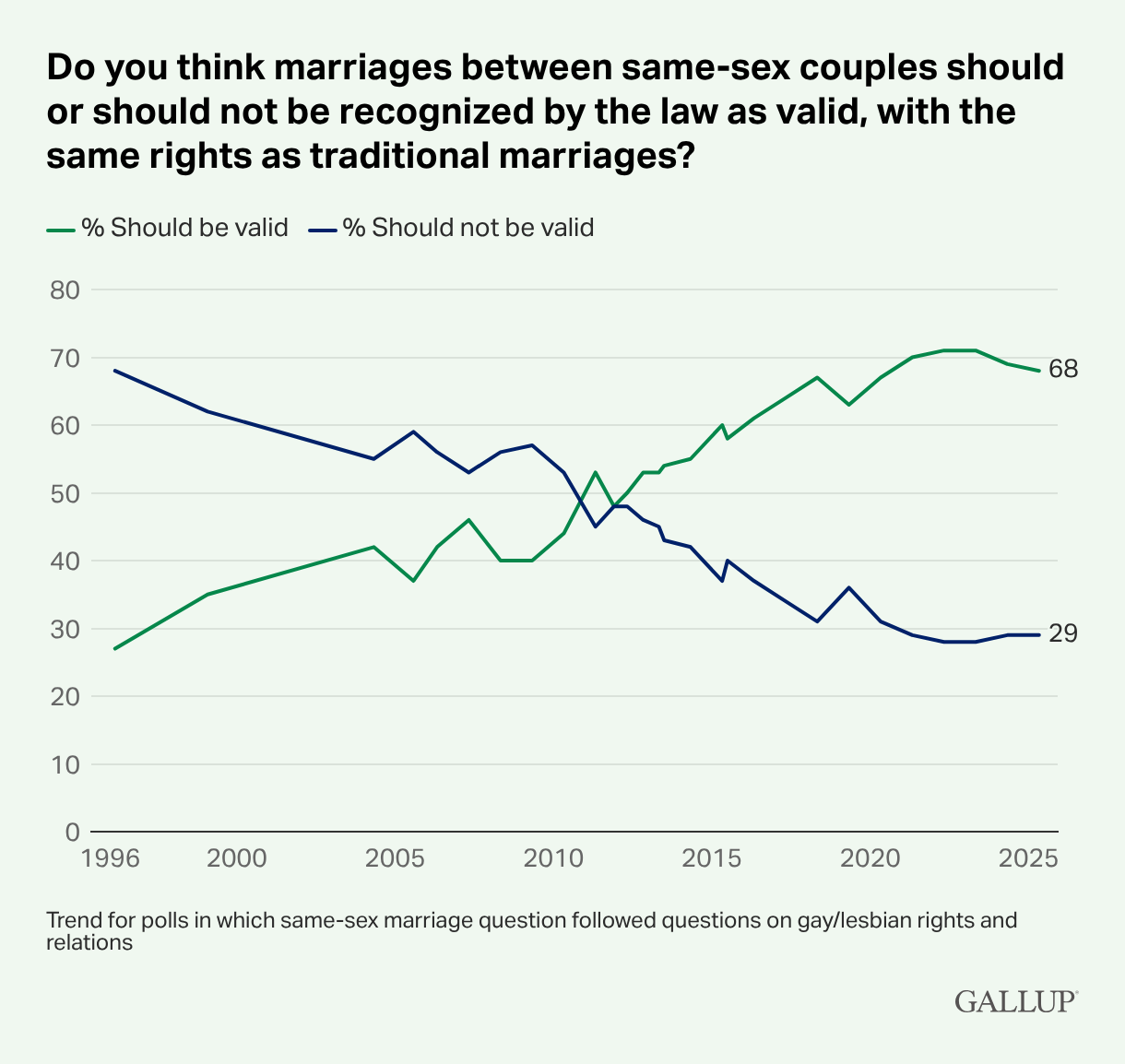
Notice how support really took off starting in 2010 after the messaging shift happened. Conversation as engine of change. Freedom to Marry invested heavily in programs designed to trigger interpersonal conversations, guided by research on persuasion. They understood that people change their minds through relationships. The campaign deliberately targeted “reachable but not yet reached” moderates and gave them emotional pathways toward acceptance through stories of parents and grandparents coming around.
From the thesis to the Obergefell decision that legalized gay marriage across the US took thirty-two years. That’s the timeline for the most deliberately planned Overton Window campaign in recent American history.
The Fastest Case: AI Safety
AI safety moved from fringe concern to government summits and Time Magazine covers in roughly fifteen years. The strategy was explicitly elite-focused:
Publish rigorous books that could serve as intellectual on-ramps (Superintelligence, The Precipice).
Build organizations like MIRI and funding bodies to professionalize the field.
Cultivate networks that placed AI safety people in academia, industry, and policy roles.
The approach worked because when ChatGPT created a moment of widespread public attention in 2022, there was already an epistemic community in place. People who shared frameworks and language were ready to shape the conversation rather than scrambling to build one from scratch. Concentrated philanthropic capital accelerated the timeline considerably, funding the organizations and research that gave the field institutional weight.
Fifteen years is still a long time. But compared to the thirty-year arcs of other successful campaigns, it shows that elite-focused strategies with sufficient resources can move faster than mass persuasion campaigns typically do.
What Makes Climate Interventions Harder
None of these movements faced the combination of challenges that climate interventions face.
Time pressure. Marriage equality took thirty years. AI safety, the fastest case, took fifteen years from founding organizations to mainstream policy recognition. We may have ten to twenty years before tipping point risks materially narrow our options. Running a thirty-year playbook on a compressed timeline may require fundamentally different tactics.
Opposition from multiple directions. Marriage equality faced organized opposition, but that opposition was external to the movement. Environmental allies weren’t attacking marriage equality advocates. Climate interventions face conspiracy theorists on one side (chemtrails, weather modification paranoia, RFK Jr. on daytime television) and mainstream environmental groups on the other (moral hazard concerns, accusations of enabling fossil fuel interests).
The nuclear power rehabilitation effort is the closest structural parallel here. Pro-nuclear climate advocates face hostility from environmental groups who should, in theory, be allies on decarbonization. Their strategy has been to reframe nuclear as a climate necessity rather than defending it on its own terms, and recent developments (global commitments to expand nuclear capacity, tech companies commissioning plants to power their data centers, and the World Bank lifting its financing ban) suggest progress. It’s worth watching as the most similar case to the dynamics climate interventions face, even though the verdict isn’t yet in.
Governance complexity varies. Marriage equality could be won state by state, building momentum toward a national resolution. AI safety could advance through elite consensus and corporate adoption. Climate interventions are more varied: stratospheric aerosol injection would affect the entire planet and require international coordination, but marine cloud brightening to protect coral reefs or interventions to stabilize ice sheets could be more regional or local. That variation matters strategically. Smaller-scale interventions might follow a “build momentum through wins” logic more similar to marriage equality, while global-scale cooling requires governance frameworks we don’t yet have.
Simultaneous need for elite and mass permission. AI safety grew primarily through elite discourse shift. You didn’t need mass public buy-in, just enough influential people taking it seriously. Marriage equality required a genuine public opinion change. Climate interventions seem to require both: institutional decision-makers need permission to act, but conspiracy-driven state legislation in Tennessee and Florida shows that mass discourse can constrain elite options. You can’t ignore either arena.
What We Can Adapt
Despite the differences, the cross-cutting patterns can be useful to us.
Make the destination explicit. Wolfson’s thesis named the endpoint when it seemed impossible. The Stabilization Framework is an attempt to do the same: name what we actually need (cooling interventions, ice sheet protection, ecosystem preservation, as part of an integrated response with emissions reduction and carbon removal) rather than hedging toward something more palatable.
Treat narrative as infrastructure. Marriage equality’s pivot from rights to love wasn’t a messaging tweak. It was a strategic reorientation that changed everything downstream. The frame shapes what’s possible. Getting the frame right is foundational work.
Build a strategy shop. Freedom to Marry served as a central hub that tested messages, tracked what worked, and diffused successful frames into every channel: litigation, legislation, media, and interpersonal conversation. Climate interventions don’t have that coordinating function. The field has researchers and policy organizations and startups, but no one is doing the systematic work of building and spreading narrative infrastructure. Perhaps the Climate Emergencies Forum can fill that role.
Find sympathetic constituencies. Marriage equality found conflicted moderates who could be reached through personal stories. AI safety found tech leaders already worried about what they were building, as well as existential risk people in the Effective Altruism movement. For climate interventions, I have been hypothesizing that the carbon removal community may be the natural starting point. These are people who already understand the timeline problem and have arrived at the same conclusions through their own experience. From there, the circle expands to climate tech generally, then to climate-concerned people across different domains.
Create intellectual on-ramps. Books like Superintelligence and Tim Urban’s seminal 2015 post The AI Revolution: The Road to Superintelligence (which blew my mind the first time I read it), served as entry points that converted interested outsiders into engaged participants. The Stabilization Plan I’m working toward is an attempt at something similar: a comprehensive resource that helps people understand the full picture and what it implies for action.
Accept losing forward. This may be the hardest lesson. The instinct is to avoid high-profile defeats. But Wolfson’s framework suggests that defeats such as the Alameda MCB experiment, properly leveraged, build capacity and clarify strategy. The question is whether we have time for the iterative learning that losing forward requires.
The honest answer to Rahul’s question is that we’re attempting something without a complete playbook. The precedents show that Overton Windows can be deliberately shifted, that explicit multi-decade campaigns can succeed, and that making the unthinkable obvious is possible. They also show that it usually takes longer than we have.
But we have tools that didn’t exist when Wolfson wrote his thesis in 1983. The attention economy works differently now. Podcasts and YouTube channels reach millions without waiting for coverage in legacy outlets. Creator networks can rival broadcast media reach. AI accelerates what small teams can produce. The gatekeepers who once controlled which ideas got airtime have lost much of their power. None of that guarantees we can compress a thirty-year arc into ten, but it changes the math on what a small group of people can attempt.
As Gimli puts it in Fellowship of the Ring: “Certainty of death. Small chance of success. What are we waiting for?”
Thank you Paul, this is brilliant. In the Healthy Planet Action Coalition we have discussed shifting the Overton Window quite extensively as a way to frame the strategic task of deploying climate cooling technologies. My view, as I discussed in my article in The Hill, is that this strategic pivot should set an Albedo Accord as the core goal, modelled on the Montreal Protocol.
The primary constituencies of support, with reason, interest and capacity to establish an effective and well funded lobbying group for sunlight reflection, are the industries who face greatest commercial risk from warming - insurance, banking, tourism, agriculture, energy, etc. I believe these industries are so embedded within the fossil economy that they are turned off by calls for rapid decarbonisation of the economy, despite ESG PR rhetoric.
That means shifting the Overton Window requires a story that supports carbon action in the longer term, but switches the immediate priority to albedo restoration. The key information is that the world has become more than 2% darker in the last 25 years, and this presents massive dangerous risks of accelerating warming. NASA CERES satellite data shows the darkening rate is now doubling every decade.
If that turns off climate activists it does not matter, as this debate will generate rapid policy change and reveal the moral vacuity of the moral hazard ideology. Calls for decarbonisation now function like your description of rights advocacy in the early gay marriage campaign, generating a polarising political paralysis, due to the futile IPCC insistence that stopping warming requires rapid and deep transformation of all sectors of the economy.
The Montreal Protocol is an excellent example of shifting the Overton Window. The realization in the 1970s that spray cans were destroying the ozone layer led to international agreement to ban ozone depleting substances within 15 years, in 1987, putting a totally obscure scientific discovery into effective international focus, against strong industry opposition. Its alliance between industry and governments presents the most successful and effective model for an Albedo Accord. We can create a similar public awareness campaign today for climate intervention to prevent the accelerating loss of clouds, aerosols and ice.
Albedo is now falling off a cliff. Immediate action can stop the avalanche.