

The Alliance for Just Deliberation on Solar Geoengineering (DSG) published a piece last week arguing that carbon removal’s trajectory offers a cautionary tale for solar radiation management. Their argument goes roughly like this: CDR was once considered taboo, but it quietly became embedded in IPCC modeling pathways before policymakers seriously grappled with it. As the field gained legitimacy, private actors and investment moved faster than governance frameworks could keep pace. Ocean iron fertilization proceeded without oversight and damaged public trust. Voluntary verification mechanisms, designed by and for commercial actors, created structural incentive problems. And the resulting pattern, where technical momentum outpaces institutional readiness, is now playing out again in the SRM space, where the stakes are even higher.
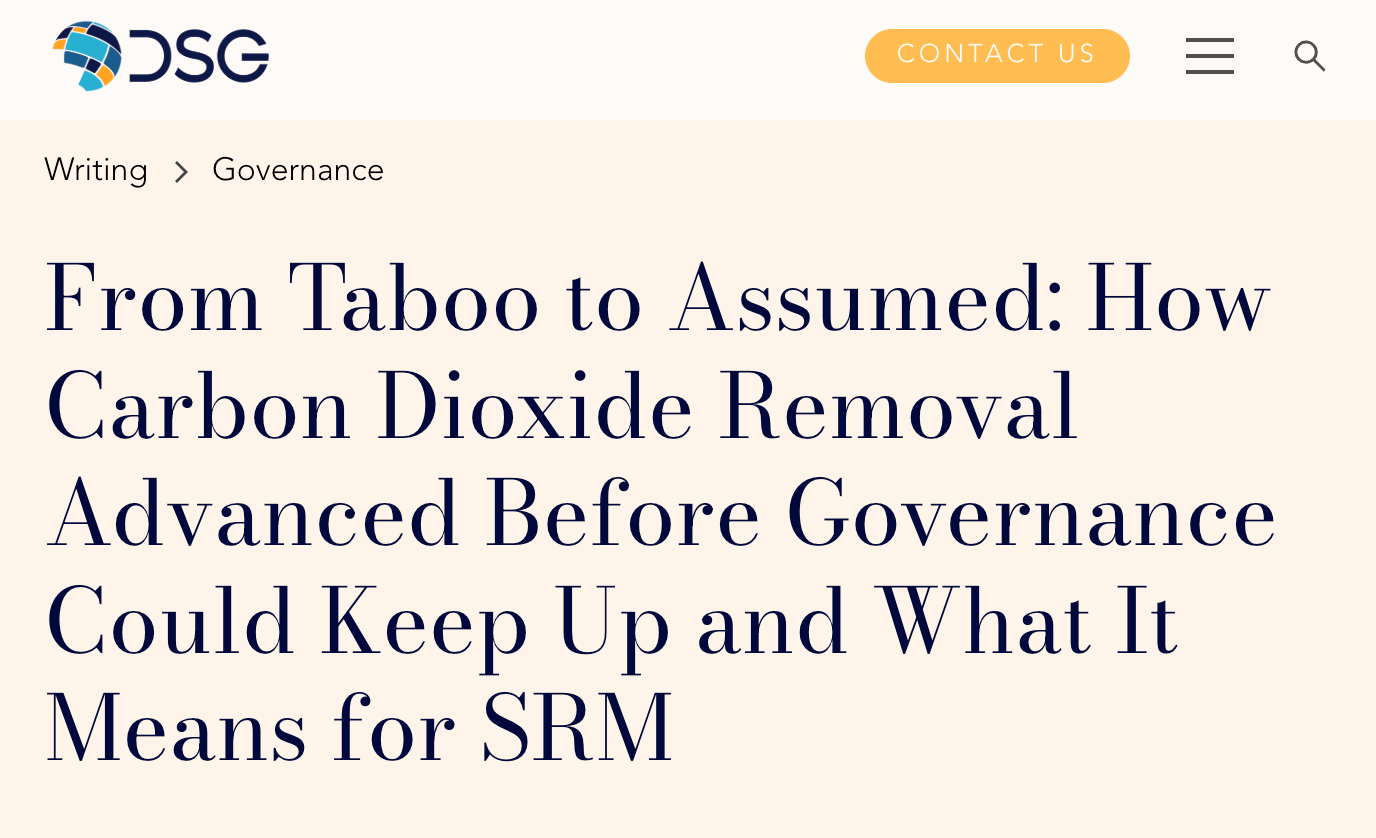
Coincidentally, on the same day that the DSG article went live, Heatmap News reported that Microsoft is pausing future carbon removal purchases. If you’re a CDR veteran like me, then your LinkedIn feed since then has been nonstop wall-to-wall think pieces about what this means for the CDR industry. And I get why! Microsoft was responsible for 90% of all CDR purchases worldwide last year. But I thought I’d share a different angle on this. Because the timing of these two articles tells you something about what carbon removal’s actual problem is, and it isn’t a lack of governance.
In 2018, my co-founders and I at Nori held a conference called Reversapalooza. The whole purpose was to convince people that pulling carbon out of the atmosphere was possible and necessary, that decarbonization alone was like slamming the brakes on a car hurtling toward a cliff when in fact you also need to turn the car around in time. We had to make that case because almost nobody in climate wanted to hear it. Carbon removal was widely seen as a dangerous distraction, a moral hazard that would let emitters off the hook. Getting investors and researchers and policymakers to take it seriously required years of work from a small community of people who believed the math was already pointing at the inescapable need to remove atmospheric greenhouse gases.
So when I read the governance-deficit version of CDR’s history, I’m reading something that doesn’t match what I lived through across nearly a decade of building this industry. And because that narrative is now shaping how people think about cooling interventions, I want to share what it looked like to me from the inside.
The legitimate governance concerns
First I want to acknowledge that I do see two fairly legitimate governance concerns in CDR’s history. The first is the Russ George ocean iron fertilization (OIF) incident in 2012, which raised real questions about oversight for open-system interventions in complex environments like the ocean. When dealing with such complex systems, there very likely needs to be more robust governance around that, or at the very least serious consideration of what the consequences would be if something goes wrong. In this case, the consequences were much more political than ecological, but the damage to the field was real.
The second is the moral hazard concern about assuming future carbon removal in climate models. Baking CDR into 1.5°C pathways before the technology existed at scale does create a risk that present-day emissions budgets are built on promises nobody can keep. Given that we are effectively in 1.5 overshoot now, that is plausible, and I take that challenge seriously.
But the governance-deficit reading of what happened after 2018 gets the story backwards in ways that matter for the conclusions being drawn.
What the IPCC moment actually was
From inside the nascent carbon removal community, the IPCC’s 2018 special report on 1.5°C looked very different than the governance-deficit narrative describes. Before that report, carbon removal was treated almost exclusively as moral hazard, a dangerous distraction from the “real work” of cutting emissions. Researchers who worked on it faced professional risk. Entrepreneurs who tried to build companies around it couldn’t get investors to take them seriously. The field existed, but barely, and under a cloud of suspicion.
The IPCC report changed that by establishing, through the most authoritative scientific process we have, that limiting warming to 1.5°C would require removing carbon from the atmosphere at scale. That conclusion went through the full gauntlet of IPCC review, and it told investors, governments, and entrepreneurs that carbon removal was a legitimate problem to work on.
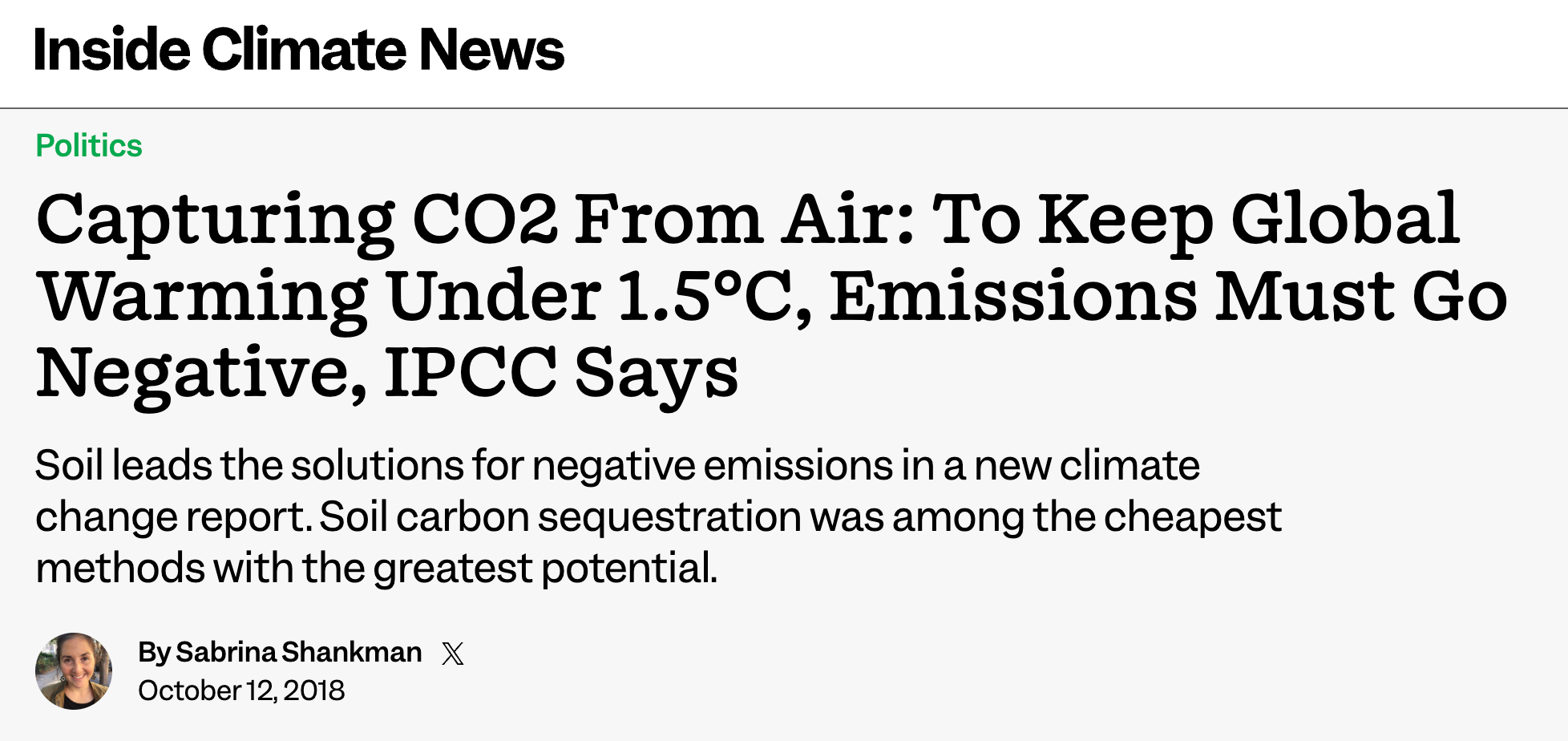
Without that legitimization, the carbon removal industry as we know it wouldn’t exist. There would be no wave of venture investment, no corporate advance market commitments like Frontier, no Microsoft pledge to go carbon negative, no federal programs funding direct air capture hubs, and no ecosystem of startups and researchers and standards bodies learning in real time how to pull carbon out of the atmosphere and prove that they did it. We’d still just have ongoing academic discussions about whether we should be allowed to try.
Robert Höglund recently reframed CDR’s current phase as being about “proving and learning” rather than rapid scale. I truly wish we had rapidly scaled the industry around the fastest and cheapest methods of removal, but that’s not what happened. And since we don’t have any clear plan on how to pay for the trillion tonnes of CO2 that need to be removed, that framing is probably the most honest description of where we are: build the industry know-how and capability now so that as financial mechanisms hopefully develop over time, we’re ready to grow when the moment comes. The value of the CDR industry right now can’t be measured primarily in tonnes removed. It has to be measured in the knowledge being generated. We continue to learn which methods work best, how to measure what we’ve removed, what financing mechanisms can sustain the work, how to engage communities, and how to drive down costs.
If the implication of the governance-deficit narrative is that this process of proving and learning should have waited for more governance infrastructure before being allowed to develop, then I’d ask what, specifically, we should have been waiting for. We can’t skip that learning phase. We can’t wait until 2040 and then decide to build an industry from scratch. It will take time to march down cost curves and uncover the unknown hurdles that invariably arise when moving from the lab to the field. Every year of development compounds, and every year of delay is a year we don’t get back.
What actually happened inside CDR
The crux of the governance-deficit narrative rests on an implication that private actors outpaced oversight, leading to verification problems and erosion of trust. It invokes the structural incentive pressures of voluntary frameworks in which verifiers are paid by project developers, and suggests this produced the appearance of oversight rather than real accountability.
Those concerns are real, but in the carbon avoidance offset market, not in carbon removal. The scandals that most people associate with carbon credits (e.g. the Verra/REDD+ collapse, the South Pole implosion, and the ProPublica investigation into phantom credits from forest protection projects) were all about carbon avoidance, where you’re trying to prove that emissions would have occurred in a counterfactual scenario. That’s where the overcrediting happened, because the counterfactuals were inherently unfalsifiable and the incentives to be generous were strong.
Carbon removal credits represent a fundamentally different kind of claim. When Climeworks captures CO2 from ambient air and injects it into basalt in Iceland, the CO2 captured can be measured by a physical process. When a biochar company pyrolyzes biomass and applies the char to soil, the carbon content is testable. The measurement challenges in CDR are real (e.g. enhanced rock weathering relies partly on modeling, ocean alkalinity enhancement also relies on modeling and involves complex systems) but the failure mode is uncertainty, not fraud. I’m not aware of a single documented case of a carbon removal company fabricating or deliberately inflating its removal claims. The closest anyone has found is a methodological disagreement about how Climeworks amortizes embodied emissions in its credit accounting, and a 2009 biochar investment fraud that had nothing to do with CDR claims themselves. And methodological disagreement is actually healthy for iterating towards a better overall monitoring, reporting, and verification (MRV) ecosystem.
The culture inside the carbon removal industry has been the opposite of what the governance-deficit narrative implies. When we were designing Nori’s verification system, we spent months wrestling with the verifier incentive problem, which is the exact concern raised in DSG’s article. We wanted buyers to fund verification, because they’re the ones who benefit from knowing a credit is real. In practice, we couldn’t make that work for our initial market. We were doing soil carbon with farmers in the US, and verification costs ran $4,000 to $5,000 per project. We used a third-party system built on a US government-funded public model called DayCent for the actual measurement (I’m not running Nori anymore, so I don’t have a lawyer in my ear saying “it’s not measurement, it’s estimation!”), with simple audits on top. Our long-term vision, which we described in Nori’s white paper (found here), was to make verification as transparent and replicable as possible, essentially open-source, so that anyone could inspect and duplicate the process the way scientific results are supposed to be reproducible.
We weren’t unique in this. The entire CDR industry has been obsessively focused on proving that its removals are real. If anything, the industry has over-indexed on measurement precision in ways that structurally limit growth and chew up valuable human and financial capital. But fraud, corner-cutting, and deliberately inflated claims? That hasn’t been the CDR industry’s failure mode.
And the timeline doesn’t add up, because the Russ George incident happened in 2012, long before the CDR industry really started to grow. I didn’t enter the space until 2015, and Nori was founded in 2017. The IPCC report came out in 2018. These were different eras and largely different communities. The CDR industry, as far as I could tell, wasn’t even really aware of the Russ George ocean iron experiment, and we focused on building rigorous verification systems anyway, because if your removal claims don’t hold up, your business is dead. We genuinely wanted to solve climate change, which means you need real removals, not paper ones. And the practical realities of working with farmers and buyers and regulators forced rigor on us anyway. The governance-deficit narrative implies a reckless industry that ignored warning signs. What actually happened is that the work itself produced the rigor.
The governance-deficit narrative treats ocean iron fertilization as representative of carbon removal broadly, but OIF is a specific approach with specific risks around ecological disruption, unpredictable nutrient cycling, and uncertain permanence in a complex ocean system. Those risks legitimately warrant careful research governance before large-scale deployment, and they resemble the kinds of risks that a deployment of stratospheric aerosol injection would carry. But the bulk of the CDR industry works in domains where the risks are fundamentally different. Direct air capture doesn’t disrupt ecosystems, nor does enhanced rock weathering trigger cascading biological effects. Soil carbon sequestration doesn’t carry planetary-scale risks. The governance challenges for these approaches rest on measurement accuracy, science, and market design, not on intervening in complex natural systems with unpredictable consequences. Generalizing from OIF to all of carbon removal, and then from all of carbon removal to SAI, compresses distinctions that actually matter.
The real problem
Microsoft has been, by every measure, the carbon removal industry’s anchor buyer, responsible for 90% of all purchases last year, with 45 million tonnes contracted in total. The next-largest buyer, the Frontier coalition led by Stripe, has purchased 1.8 million tonnes. When a single company accounts for that much of an entire market’s demand, you don’t have a market so much as a dependency, and the company on which everything depends just stepped back.
I wrote about this structural fragility a year ago in “Carbon Removal’s Wrong Turn.” The industry designed itself as a monopsony (i.e. a market dominated by a single buyer class) and then built an elaborate supply-side infrastructure of standards, registries, and verification protocols to serve that buyer class. Corporate sustainability departments with limited budgets and high risk aversion became the target customer. The result was a system that prioritized credit quality and measurement precision over atmospheric impact and scaling, because that’s what those buyers needed to protect their reputations.
Carbon removal doesn’t lack governance. If anything, it is drowning in it. Registries like Puro and Isometric certify projects as having actually removed CO2 and issue the credits. Ratings agencies like Sylvera, BeZero, and Calyx Global provide ratings on both projects and measurement methodologies. For a while in the first half of the 2020s, it felt like everyone in climate tech wanted to start an MRV company. The industry has built more accountability infrastructure than almost any nascent sector I can think of, and the result hasn’t been trust and order. It’s been confusion and fragmentation that makes it even harder for new buyers to enter the market, because nobody can tell which standard to trust or which rating to believe.
And the costs to support this measurement and verification ecosystem are high on both sides! CDR providers have to fill out lengthy, detailed applications for every ratings agency and registry they want to work with, and though the content is essentially the same, every organization uses a different format, so companies end up burning enormous amounts of time on what is basically bureaucratic red tape instead of removing carbon. On the buyer side, offtake contracts have grown extraordinarily complex as every conceivable risk factor and reversal scenario gets incorporated into the legal frameworks, creating yet another barrier to participation for anyone who isn’t a major tech company with dedicated legal teams.
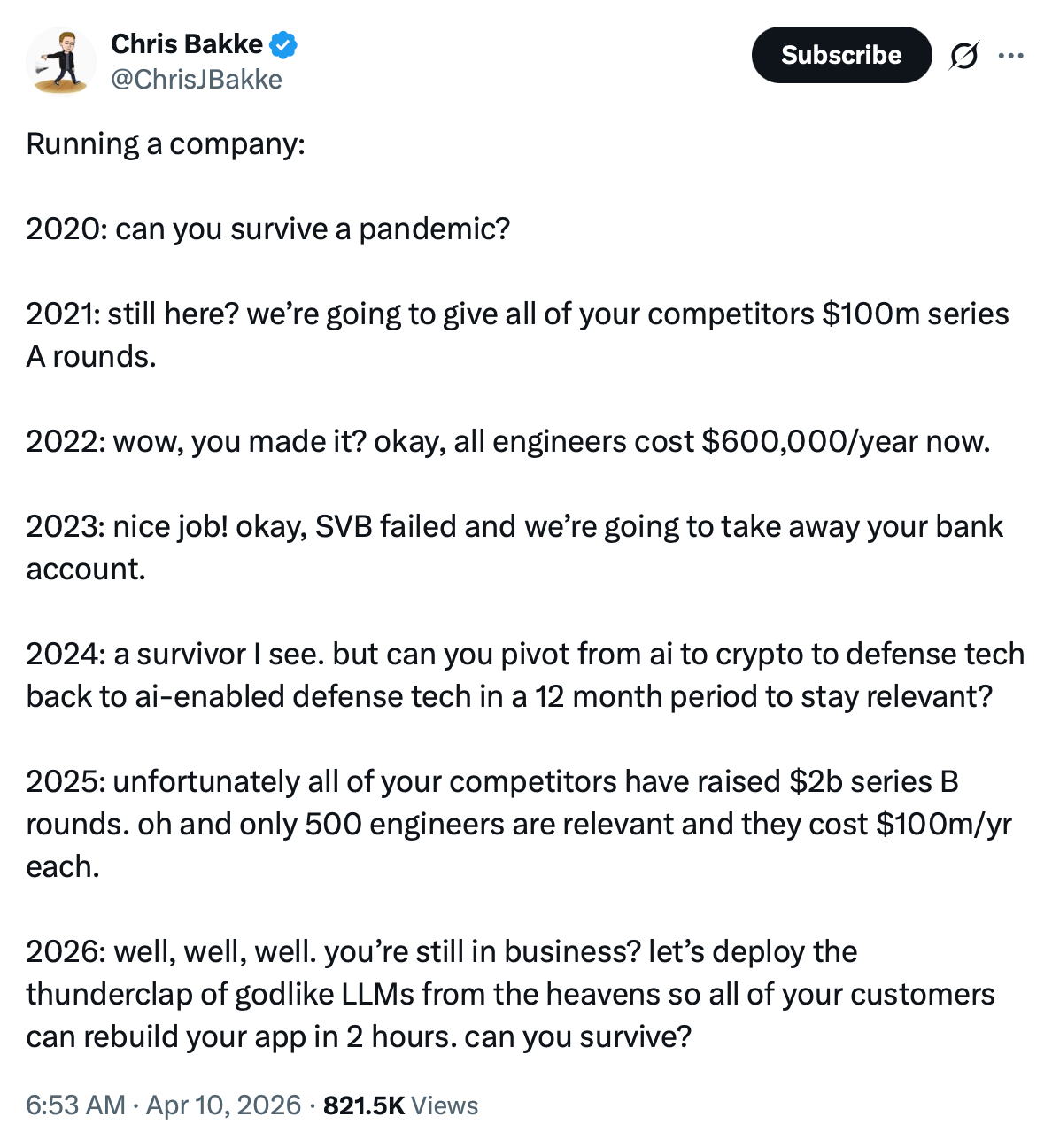
People inside the industry have been wrestling with these structural problems from the very beginning. At Nori, we tried to sidestep some of this complexity by only selling ex-post credits—carbon dioxide that had already been removed—backed by a warranty, rather than trying to build the entire apparatus of forward contracting and risk allocation that made other models so cumbersome. Other teams took different approaches. The governance challenges this narrative describes weren’t being ignored by an industry racing ahead recklessly. They were being actively worked on by founders and researchers navigating an impossibly difficult environment, building companies through a pandemic, inflation and interest rate increases, regulatory whiplash, and a market that isn’t really a market, while simultaneously trying to invent the measurement, verification, and market infrastructure that the field needed to function.
Meanwhile, the actual question of who pays for gigatonne-scale carbon removal beyond a handful of tech companies’ sustainability budgets has never been answered. That’s the problem we saw when we started Nori. We tried to build the financial infrastructure that made it as easy as possible for people to pay for carbon removal, initially through crypto-based mechanisms that could create broader market participation. Regulatory and practical barriers kept us from executing that vision, but we understood from the beginning that the supply side without the demand side was going to produce exactly the crisis the industry is now experiencing.
None of this is to say that the people building standards and verification infrastructure were wrong to do so. My whole argument here is that it’s a good thing that the CDR industry cared about getting verification right! The problem for the industry, though, is structural, not individual, and it’s not about missing governance. The system oriented itself around a tiny buyer class and optimized for their needs, and the result is an industry that's incredibly good at proving what it removes but isn’t sure about where to go from here.
What this means for the conversation ahead
I share the concern about private actors moving ahead of governance in the sunlight reflection space. I’ve written about the structural problems of venture-backed companies developing proprietary intellectual property for planetary-scale interventions, and I pushed back on the notion of acting now without accounting for bigger risks in a recent podcast conversation with Luke Iseman of Make Sunsets. I want robust governance for cooling technologies. I want it to be fair and inclusive and oriented toward managing real risks.
But I also want governance that prepares us for decisions we will need to make, not governance that substitutes for making them. And I want something CDR has not yet built: the operational capacity to actually scale up when the time comes.
Governance frameworks for something like stratospheric aerosol injection aren’t just about deciding whether and when to deploy. They need to address how we build international monitoring infrastructure, how we coordinate deployment logistics across nations, and how we will manage a program that will need to run for decades or centuries. The governance question and the operational question are inseparable. If funders and policymakers look at CDR and conclude that the main lesson is to build governance infrastructure before doing anything else, they risk repeating exactly what CDR did, building elaborate process while leaving the harder questions of financing, operational capacity, and practical readiness unanswered. The climate stabilization field doesn’t need to repeat that pattern, spending years building governance process while the operational capacity to actually do the work goes unbuilt. We need both to happen simultaneously.
This and every other article I publish is free because I want these ideas to reach as many people as possible. Paid subscriptions are how I keep doing this work independently. They allow me to follow the research on climate interventions and meet the researchers, practitioners, founders, and policymakers shaping how this landscape evolves.
Paid members get access to our community chat, where we discuss the latest developments in climate interventions and make sense of them together. I’m sharing all the really interesting videos, papers, stories, and other links I’m coming across in there. If you’ve found value in this newsletter, I’d appreciate your support.
Good stuff as always, my friends. Rhymes and continues trends from this beast we put together a while back ;)
https://www.keepcool.co/p/we-won-t-achieve-gigatonne-carbon-removal
What I fear Paul is what happened to renewables when we needed them. Climate is f'd because they are now "weknewables". Will SRM get the thumbs up at +5C?