
What It Takes to Make Cooling Interventions Thinkable

Tomorrow, on Tuesday December 9th at 9am PT, I will be joining Sebastian Manhart for a LinkedIn Live event titled: What Is Global Cooling? We’ll be talking about many of the topics in this and my previous articles, with a particular focus on what a CDR audience should consider when it comes to geoengineering. Join us here: What Is Global Cooling?

This past October, I co-hosted a dinner in London with Tito Jankowski from AirMiners. We were at the Carbon Unbound conference, and after day one wrapped, about 20 carbon removal founders gathered in a private dining room near Liverpool Street Station.
We called it “Are We On Track?” We didn’t mention that we’d be getting into cooling interventions.
We opened with a presentation on catastrophic tipping point risks—AMOC collapse, ice sheet destabilization, and Amazon dieback. We walked through the timeline reality: warming acceleration and the gap between where CDR is now and where it would need to be. If we’re going to hit 10 billion tonnes of removal by 2050, the scaling curve says we should be approaching hundreds of millions of tonnes by 2030. That’s four years away. We’re currently doing single-digit millions. We asked the room: Do you think we’re on track?
Throughout the presentation, we broke into smaller discussions. Tito, Mark Turner from SRM360, and I facilitated conversations about the timeline problem, tipping point risks, and eventually the cooling interventions that might buy us time—stratospheric aerosol injection, marine cloud brightening, approaches that most of them had heard of but never really engaged with.
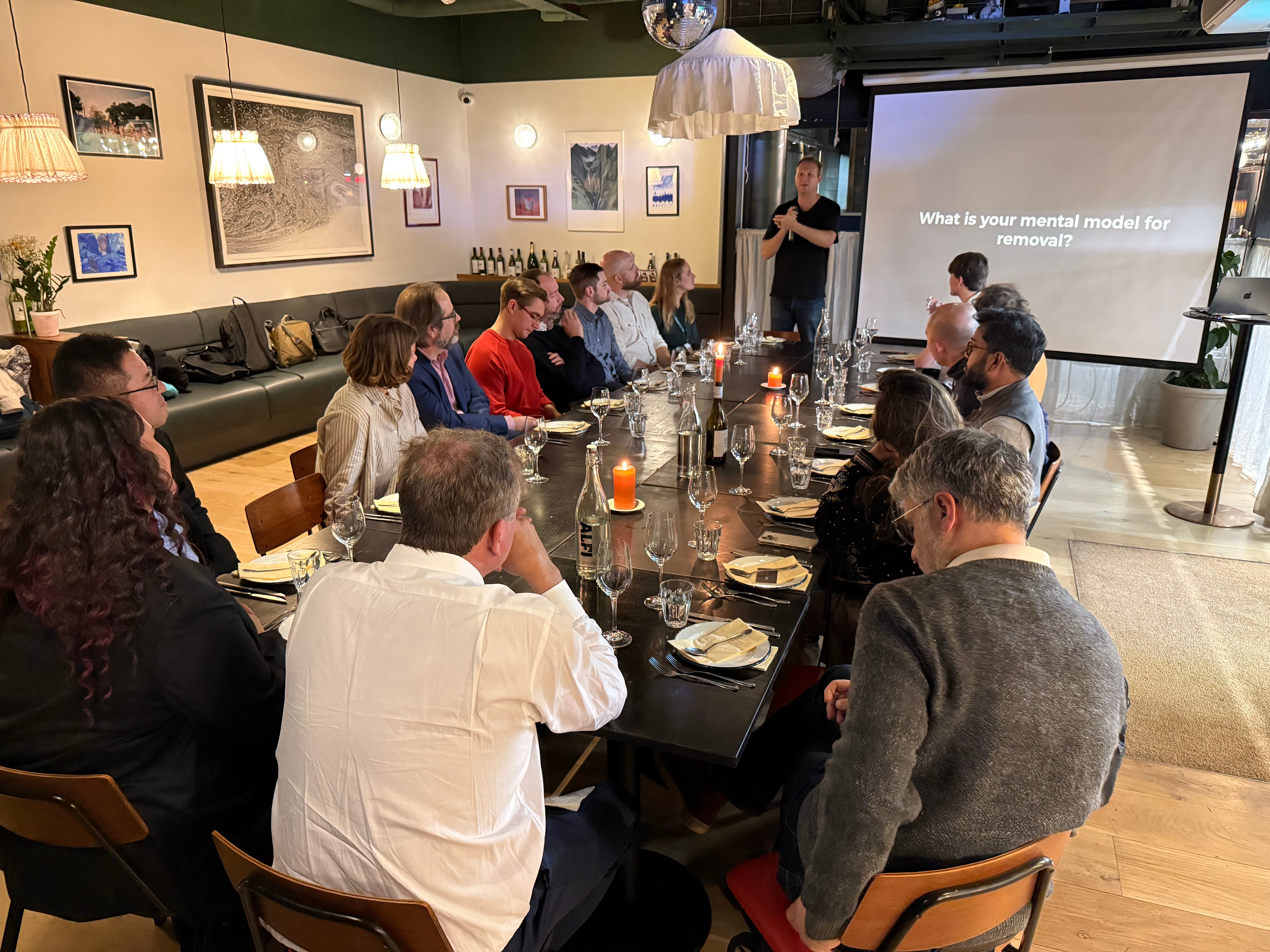
Towards the end, someone at the table said something that’s stuck with me: “This is crazy, and I don’t think we should do it, but I want to learn more.”
That’s the response I was hoping for. I wouldn’t expect anyone to react enthusiastically to this stuff—that would be kind of weird. And I’d hope they wouldn’t dismiss it outright, because then we’d have failed at what we were trying to do. What I wanted was honest discomfort paired with intellectual curiosity. That’s what we got.
This piece is about why CDR people are uniquely positioned to engage with cooling interventions, and what that means for how we close the perception gap.
The Context Problem
I spend a lot of time thinking about how we get from where we are now—cooling interventions as a taboo topic most people haven’t engaged with—to where we need to be: a society that’s informed enough to make good decisions about these tools before we’re desperate.
The bottleneck isn’t technology or cost. Unlike solar panels or DAC plants, you can’t just point to a working system and let results make the case. The barriers are cognitive and political: governance, research gaps, and public understanding. Whether we’re ready to use these tools responsibly when we need them depends on whether enough of the right people understand them to have informed conversations. Right now, we can’t even get to the hard questions about governance and deployment because most people don’t know the basics.
So if the goal is closing that perception gap, the question becomes: who’s closest to having the context they need? Where’s the shortest path?
Most climate intervention content doesn’t help here. Academic papers and specialist conferences assume you already get it. Basic explainers assume you need to learn what albedo means. There’s almost nothing for people who are partway there.
Two Dimensions of Awareness
I used to think of this as a ladder composed of rungs of understanding, with SRM researchers at the top and the general public at the bottom. Just move people up the ladder, and we’d get more understanding and awareness.
I’ve come to realize that framing is incorrect, however. There are actually two separate things people need to understand.
The first is timeline awareness. How deeply have you internalized that our current approach isn’t working fast enough?
Some people still believe the clean energy transition will handle climate change on its own. Others know we need carbon removal but assume we’ll scale it in time. Some are starting to realize CDR isn’t scaling fast enough. And a smaller group has accepted that even with maximum effort, CDR mathematically can’t close the gap before we hit tipping points.
The second is intervention awareness. How much do you know about cooling methods?
Some people have never heard of them, or only know the chemtrails conspiracy version. Others are vaguely aware SRM exists but think it’s fringe science fiction. Some know the methods exist but haven’t looked into specifics. And a small group actually understands the approaches, the trade-offs, and the governance challenges.
The moment when cooling interventions start to seem necessary—not desirable, but necessary—is when someone gets far enough on both dimensions. You need to understand how bad the timeline problem is AND understand that these tools exist and what they involve.
One without the other doesn’t get you there.
Where CDR People Sit
Here’s what I’ve noticed: CDR people are already far along on understanding the timeline problem. They just haven’t engaged with cooling interventions.
All of them know CDR is necessary. That’s why they’re in the field. Many are starting to worry about whether it’s scaling fast enough. They see the gap between where we are and where we need to be. Some have fully internalized that even heroic scaling efforts probably won’t close the gap in time for tipping points.
But on intervention awareness? Most have barely engaged. They’ve heard of geoengineering, usually with negative connotations. They haven’t looked into how SAI or MCB actually work, what the trade-offs are, or why governance rather than technology is the real bottleneck.
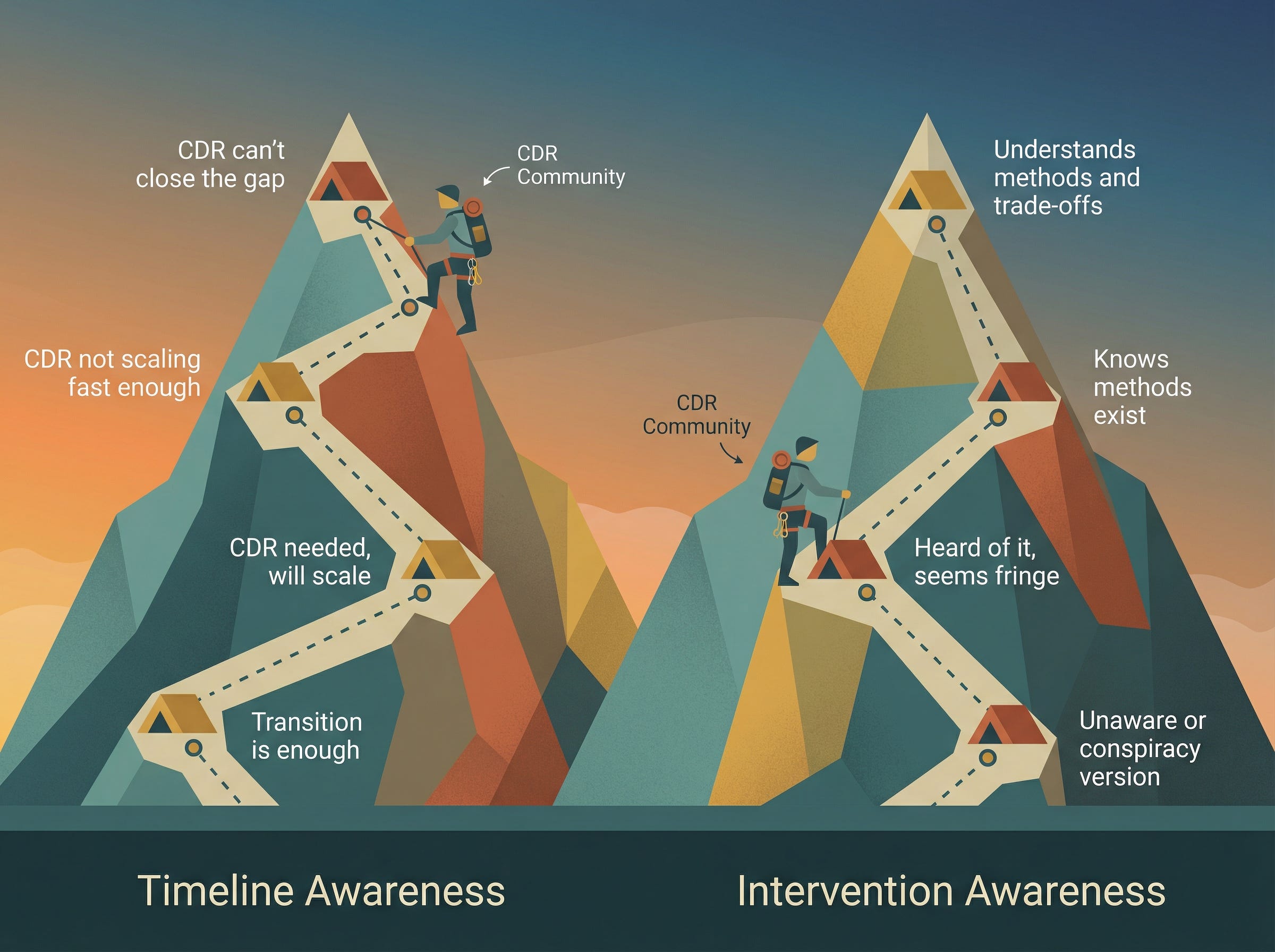
Compare that to other groups. Sustainability professionals often still believe mitigation plus some CDR will handle everything. Climate-engaged consumers might not even know what carbon removal is. These folks need to move on both dimensions, which means they’re further from the destination on both fronts.
CDR people are one dimension away. Everyone else is two.
What CDR People Already Have
The carbon removal community has done a lot of cognitive work that most people haven’t.
They’ve accepted that reducing emissions isn’t enough. That was itself controversial not long ago. They’ve made that leap.
They’ve dealt with the moral hazard argument. “CDR lets polluters off the hook!” They’ve heard this, wrestled with it, and concluded the tools are still necessary. They know how to think about approaches that could theoretically be misused as excuses for inaction.
They’ve internalized that timing matters. Carbon removal isn’t just about pulling CO2 out of the atmosphere eventually. It’s about doing it fast enough to matter. When you act affects what’s possible.
They think in portfolio terms. Climate response isn’t one solution. It’s a set of approaches working together. This is just obvious to CDR people.
And they understand the scale problem viscerally. The gap between current removal capacity and what we need isn’t abstract to them. Anyone who’s tried to build in this space feels it.
That’s a lot of ground already covered.
What’s missing is smaller. The specific math showing that even aggressive CDR can’t scale in time for tipping points. Awareness that cooling interventions are real options, not science fiction. Understanding that governance and politics are the blockers, not technology. And maybe some permission to engage with this stuff without feeling like they’re abandoning the mitigation mission.
Getting Up to Speed
I’ve written about both of these dimensions elsewhere, so I won’t rehash everything here.
If you want to go deeper on the timeline problem—why I think even aggressive CDR scaling won’t close the gap before tipping points—I wrote about James Hansen’s acceleration paper and my own “timeline collapse moment” in Break Glass, Cool Planet. The CDR scaling math specifically is in We Won’t Achieve Gigatonne Carbon Removal.
If you want to understand cooling interventions themselves—the methods, trade-offs, governance challenges, and why this isn’t science fiction—I put together a resource guide: How to Learn Everything You Need to Know About Climate Cooling.
When both pieces click, the conclusion isn’t that we should deploy tomorrow. It’s that we need to take this seriously now, while there’s still time to prepare responsibly.
What the Dinner Showed
We didn’t open that London dinner by arguing for geoengineering. That would’ve been the wrong move.
We started with questions CDR people already cared about. Are we on track? What happens if removal doesn’t scale fast enough? What options do we actually have?
The cooling methods came last, after we’d established the timeline reality. By that point, people weren’t asking whether these tools were legitimate. They were asking what they needed to learn.
The pattern across the conversations was pretty consistent. Initial discomfort that this feels like giving up on mitigation. Then some version of intellectual honesty—but if the math doesn’t work, what’s the alternative? And then curiosity: “I don’t know enough about this yet.”
That’s the response I was hoping for. Discomfort plus curiosity. A willingness to engage with something that feels wrong because the stakes demand it.
What I’m Asking
If you work in carbon removal, you’ve already done most of the hard work.
You’ve accepted that mitigation alone won’t solve this. You’ve navigated the moral hazard debates. You think in portfolio terms. You know the timeline matters.
I’m not asking you to become an SRM advocate. I’m asking you to get informed. Understand the methods well enough to form an opinion. Know the trade-offs, the governance challenges, the open questions.
Because this conversation is going to happen. And when it does, you’ll want to have done the reading.
“This is crazy, and I don’t think we should do it, but I want to learn more.”
That’s where it starts.
This and every other article I publish is free because I want these ideas to reach as many people as possible. Paid subscriptions are how I keep doing this work independently. They allow me to follow the research on climate interventions and meet the researchers, practitioners, founders, and policymakers shaping how this landscape evolves.
Paid members get access to our community chat, where we discuss the latest developments in climate interventions and make sense of them together. I’m sharing all the really interesting videos, papers, stories, and other links I’m coming across in there. If you’ve found value in this newsletter, I’d appreciate your support.
I really liked this framing: "CDR people are one dimension away. Everyone else is two."