
Why Countries Aren't Ready for Climate Interventions Yet
You have to define the problem before jumping to the solution

Correction: This piece originally stated that Mexico had banned all geoengineering, which is incorrect. In 2023, in response to Make Sunsets releasing balloons with SO2, the Mexican government announced its intent to ban geoengineering, but as of February 2026, they have not put the ban into effect.
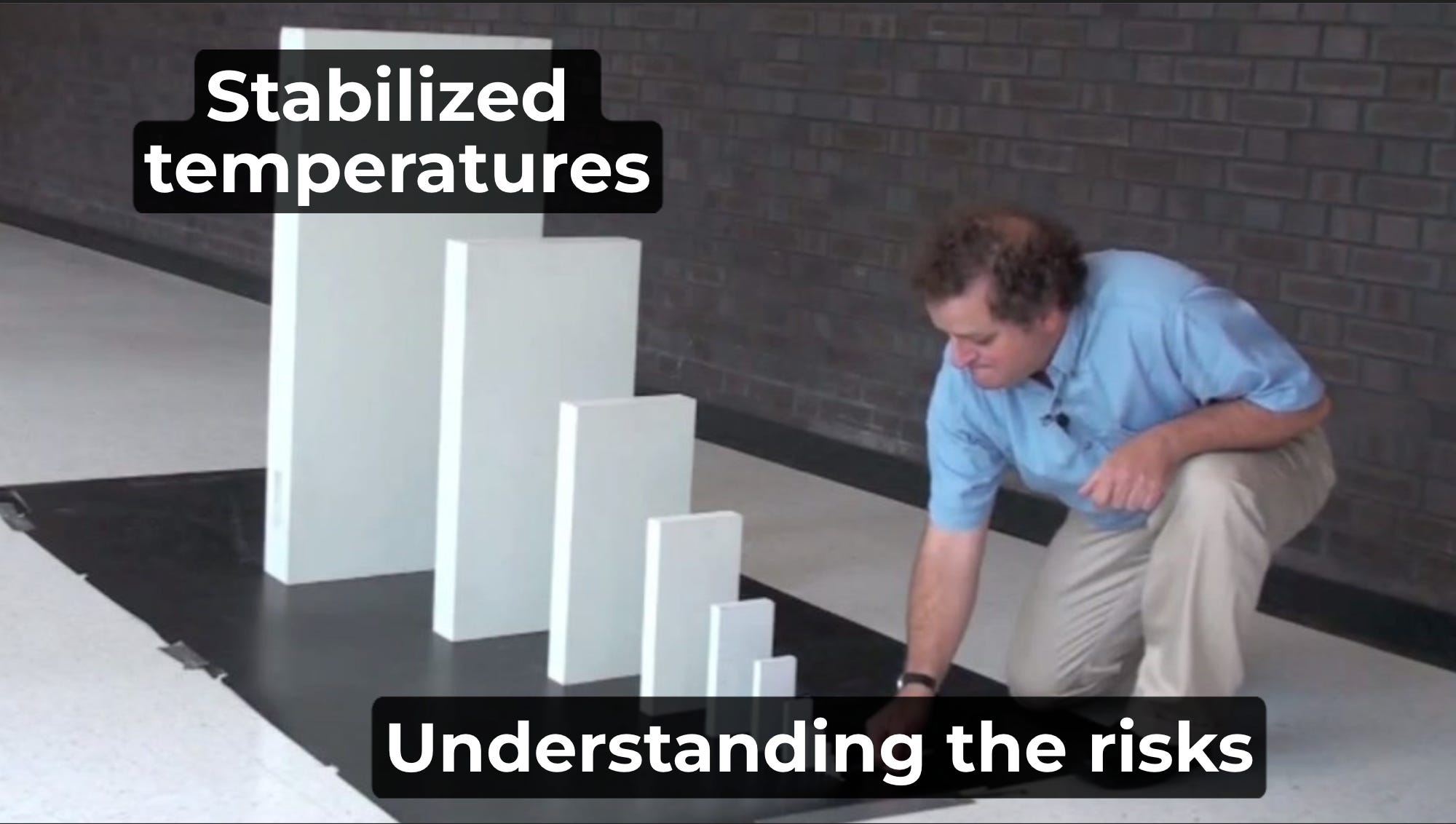
Something that has always been a challenge for me is that I make logical leaps in my head and then jump into conversations, assuming the other person is right there with me. It rarely works. And when it doesn’t, it’s not just that they don’t follow along. It’s that they sometimes end up disagreeing on principle, because they feel like something is being pushed on them that they didn’t ask for.
For years at Nori, we tried to sell carbon removal credits to companies that had publicly announced sustainability commitments. These were companies that genuinely cared about their environmental impact. But carbon removal is abstract and invisible, and it's always been a tough sell. Eventually, we noticed that companies seemed to go through a three-stage process in their sustainability journey.
First was identifying their carbon footprint and environmental impact and figuring out how to measure all of that, which is no small task for a larger business.
Second was doing what they could to reduce that impact, and not just carbon—plastic waste, water waste, supply chain inefficiencies, all of it.
Third, if they got there, they would pay for carbon removal to address what couldn’t be reduced.
Very few companies ever made it to that third stage, but the ones that did had two things in common: the capability to identify why and how much carbon removal they would buy, and the willingness to do it, often driven initially by a single champion inside the organization. My friend Tito Jankowski, who founded AirMiners and has done more than anyone to build the CDR startup ecosystem, talks about this a lot. It almost always starts with one person who goes deep enough on the problem to really feel it and then becomes the internal evangelist. But even that champion can’t get anywhere until the institution around them has gone through its own stages of understanding. You need both the individual conviction and the organizational readiness, and the organizational readiness only comes from doing the foundational work first.
One time, we pitched Alaska Airlines on carbon removal credits. Airlines were generally interested in carbon emissions, but in the end, Alaska found it too confusing or risky or whatever other reasons they had, and instead, they focused on reducing plastic waste and started using those boxed waters on flights. And honestly, that made sense for where they were. They hadn’t gone through the earlier stages yet. We were trying to skip them to the answer before they’d fully internalized the problem.
I keep thinking about this pattern because I’m watching it play out right now between countries and climate interventions, and it’s helped me understand something about why the politics of this space look the way they do.
For decades, the way most governments have thought about climate change is basically linear. Temperatures will go up gradually, seas will rise gradually, the weather gets worse over time, and you respond to all of these harms with mitigation (decarbonization) and adaptation. That framing has produced real progress on clean energy and emissions standards. But of course, the science increasingly doesn’t support the assumption of predictability behind it. The climate system has tipping points. These are thresholds where changes become self-reinforcing and irreversible, regardless of what we do afterward. The looming threats include AMOC collapse, ice sheet destabilization, permafrost methane release, Amazon dieback, and more. And these are not theoretical anymore, as coral reefs are now said to be past their tipping point of recoverability.
Countries are starting to reckon with this, and they’re going through their own version of those three corporate stages.
Stage one is acknowledging that the risks are non-linear, that the Earth system has thresholds we might be approaching or have already crossed.
Stage two is acting on that understanding within the existing toolkit. This means faster decarbonization, more carbon removal, and better adaptation. All of that matters.
But stage three is accepting that all of it may not work fast enough to prevent cascading failures, and beginning to seriously research climate interventions like sunlight reflection methods, marine cloud brightening, and ice sheet stabilization.
Most countries haven’t completed stage one. There are a handful who are working through stage two. And essentially none have arrived at stage three. I’m going to argue here that this sequencing matters enormously.
Risk-first successes
The UK is a good example of how difficult stage one can be. In late November 2025, ten experts delivered a national emergency briefing to about 1,200 British leaders at Central Hall Westminster—politicians, executives, faith leaders, etc.—modeled on the COVID briefings. The topic was the full scope of environmental and climate risk. The ten experts focused on just risks and didn’t mention potential interventions. This was purely stage-one work, and even that was eye-opening for much of the audience. According to one of the presenters, fewer than 15% of British MPs in one survey knew that global emissions needed to peak by 2025 for any chance at 1.5°C.
Then in January, the UK’s national security assessment on ecosystem collapse came out. And this one was especially interesting because this was not voluntary. Instead, someone filed a freedom of information request after Downing Street tried to suppress it, reportedly because the findings were too negative. As George Monbiot wrote:
The most important document published by the UK government since the general election emerged last week only through a freedom of information request. The national security assessment on biodiversity loss and ecosystem collapse was supposed to have been published in October 2025, but the apparatchiks in Downing Street sought to make it disappear. Apparently there were two reasons: because its conclusions were “too negative”, and because it would draw attention to the government’s failure to act.
The assessment, compiled with input from MI5, MI6, and GCHQ, warned that every critical ecosystem is on a pathway to irreversible collapse. This was a government trying to bury what its own intelligence agencies are telling it. That’s stage one on hard-mode.
And yet, others inside the UK system have clearly gone through their own version of the journey. In 2025, the Advanced Research and Invention Agency committed around £57 million to its “Exploring Climate Cooling” programme. They are funding 22 projects across SRM modeling, marine cloud brightening, Arctic sea ice restoration, and more. NERC added another £11 million for SRM impact modeling. The government’s official line is that this is about understanding options, not deploying them. But somewhere in that bureaucracy, there are champions who’ve done the stage-one and stage-two work internally and are laying groundwork for stage three while the broader leadership class is still absorbing the basics. This is the same dynamic I described with companies and carbon removal. It starts with one person who gets it, trying to drag the rest of the organization forward.
Iceland is further along. In November 2025, their climate minister brought AMOC collapse before the National Security Council as an existential threat—the first time any country had formally treated a specific climate phenomenon that way. “We cannot afford to wait for definitive, long-term research before acting,” Climate Minister Johann Pall Johannsson said. Stage one complete, working through stage two.
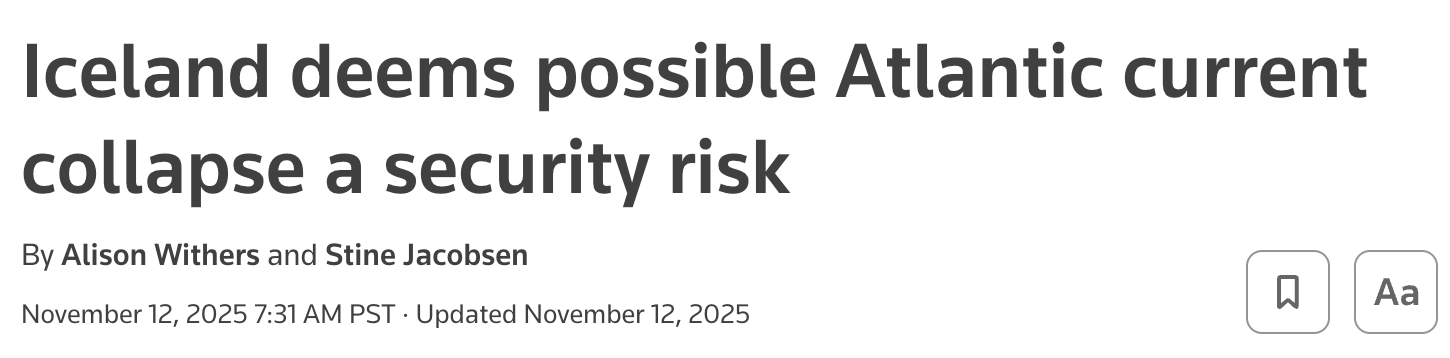
But the most interesting document I’ve seen recently is the Nordic Council of Ministers’ report on AMOC tipping risks, published just last week. The Nordic Council of Ministers is how Denmark, Finland, Iceland, Norway, and Sweden coordinate on shared policy challenges, so when they commission something with 60 contributing experts, it carries weight across the region. And what struck me reading it is that you can actually watch a stage-two-to-three transition trying to happen on the page.
The report establishes that the uncertainty range for the AMOC tipping point starts at 1.4°C of warming, that we’re already at roughly 1.4°C, and that 1.5°C will be reached within years. It describes what collapse could mean for Northern Europe: plummeting winter temperatures, disrupted food systems, and geopolitical instability. And then in Section 3.3, it arrives at climate interventions. It acknowledges that SRM “could provide additional means to limit global warming levels.” It cites studies showing that polar SAI could reduce AMOC weakening and “could be feasible more quickly, rebuilding existing aircraft.” It also engages seriously with the science of marine cloud brightening over the North Atlantic.
From everything I’ve read in the last year, this feels like actually a huge inclusion. Almost every tipping point discussion I have seen from academics has concluded with the same old “…and that’s why we need to focus on rapid decarbonization.” This actually leaned into what we might do about the risk. Though I do wish the recommendations went a bit further. The report calls for “balanced, ethical research” and regulation “against premature or unilateral implementation.” More research is absolutely the right call as that’s exactly what should happen next. But given what the analysis just laid out about where we might already be relative to the tipping point, I’d want to see that call for research come with a real sense of urgency behind it. Less “we should look into this carefully” and more “we need to understand this as fast as we responsibly can because the timeline may be shorter than we thought.” I think the next version of something like this, a few years from now, will probably read that way.
Solution-first is easier to oppose
The risk-first framing has actually been working in the Nordics and UK. Now consider what has been going on in other parts of the world, where those stages were skipped entirely.
In Mexico, Make Sunsets released sulfur dioxide balloons in Mexican airspace without consultation. That was the Mexican government’s introduction to solar geoengineering. It felt like unauthorized experiments over their territory, and so they announced an intention to ban all SRM experimentation (though they have not yet put it into effect, three years later.)
But in parts of Africa and the Pacific, the pattern was actually reversed. It wasn’t the intervention community that jumped to the solution, it was the opposition. Groups opposed to SRM engaged with government leaders and built coalitions around rejection, framing climate interventions as neocolonialism and unacceptable risk, often before those same leaders had deeply engaged with what non-linear tipping-point dynamics might mean for their own populations. The African Ministerial Conference on the Environment called for a global non-use agreement. Vanuatu argued at the ICJ that solar geoengineering is inconsistent with international law. These are sovereign governments making serious decisions, and the sovereignty concerns are real. But the conversation they were brought into centered the solution, not the problem. And it was opponents, not advocates, who set that frame. Now those political positions exist, and they’re going to be hard to revisit even as the risk picture evolves.
So you end up with the same result from opposite directions. Make Sunsets skipped to the answer from the pro side. Anti-SRM campaigns skipped to the answer from the opposition side. In both cases, the underlying problem—what do cascading tipping-point risks actually mean for these specific countries and populations—never got its day in court.
The difference between institutional shifts and mass awareness
I know some people will read this and think: hasn’t the climate movement been leading with risks and catastrophe for decades, and hasn’t that failed to move people? That’s a fair point when it comes to mass public campaigns. Telling the general public that the world is ending hasn’t been an effective way to build political will. But that’s not what I’m talking about. I’m talking about institutional buy-in. This means getting civil service agencies, national security councils, and scientific advisory bodies to do their own rigorous analysis within their existing mandates. An intelligence agency doesn’t need to be emotionally persuaded about climate change. But it does need to understand that AMOC collapse is a national security threat that falls squarely within what it’s already supposed to be assessing. An agricultural ministry needs models showing what monsoon disruption does to food systems. That kind of specific, concrete risk work is what actually creates the conditions for a country to eventually consider interventions, because it builds understanding across the institutions that would need to support any decision. That’s what happened in Iceland. That’s what’s happening, slowly, across the Nordics.
And I think that points toward what the intervention community should be focused on right now. I don’t think we should be advocating for interventions directly. Not yet, and not to audiences who haven’t done the foundational work. Instead, the best thing we could do is help accelerate the transitions between stages. We should help more governments do the kind of specific, rigorous risk assessment that makes the intervention question arise naturally from their own analysis, on their own terms, rather than arriving as a proposal from outside. Create the conditions where champions can emerge inside governments the way they emerged inside companies so that people who’ve gone deep enough on the problem to feel its weight can bring their institutions along.
At Nori, the companies that eventually bought carbon removal were the ones that had gone through the earlier stages themselves. By the time they arrived at stage three, nobody had to sell them on it. The decision felt obvious because they understood the full picture. I believe the same will be true for countries. The goal isn’t to convince skeptical governments to accept something they haven’t asked for. It’s to help them arrive at a place where they’re asking the right questions, and then trust that honest engagement with the problem leads to honest conclusions about what the response needs to include.
This and every other article I publish is free because I want these ideas to reach as many people as possible. Paid subscriptions are how I keep doing this work independently. They allow me to follow the research on climate interventions and meet the researchers, practitioners, founders, and policymakers shaping how this landscape evolves.
Paid members get access to our community chat, where we discuss the latest developments in climate interventions and make sense of them together. I’m sharing all the really interesting videos, papers, stories, and other links I’m coming across in there. If you’ve found value in this newsletter, I’d appreciate your support.
Paul, I respect your work and really appreciate you engaging with climate interventions.
However, 2 issues:
1. Please correct your assertion that Mexico has banned solar geoengineering and note your mistake. Mexico has not 'banned solar geoengineering', nor does the article you link to assert that they have done this. No nation has banned solar geoengineering. Claiming our actions have resulted in non-existent national bans may dissuade companies and nations from taking the rapid action to Cool Earth that the climate emergency demands.
2. You seem to view Nori (and broadly the field of CCS) as a success story: a model for us to emulate. Why? We emit record amounts of net greenhouse gases every year. If this is success, what would failure have looked like?
Happy to speak more in-depth, ideally publicly.
-Luke
Hi Paul, my main concern here is the engagement process, but first I want to challenge the claim "fewer than 15% of British MPs in one survey knew that global emissions needed to peak by 2025 for any chance at 1.5°C". This begs the question, assuming the dubious proposition that emission peaking is determinant for temperature peaking. It seems far more likely that albedo will be the main variable controlling planetary heat, and that restored albedo could return the planet below 1.5 even while emissions continue. The claim you quote comes from the IPCC, and is constrained by the conflict of interest generated by its advocacy for renewable energy as the primary climate response.
On your ideas about engaging with government about sunlight reflection, I doubt this will get far until key industries who face commercial damage from heat come on board. So I would suggest engaging more intensively with insurance, reinsurance and actuarial studies based on the UK Exeter Climate Scorpion reports, in order to mobilise the constituency of support needed to lobby governments effectively. In the US, corporate lobbying outweighs community lobbying by about 100 to 1 in terms of funding. Sunlight needs a corporate lobby to get proper government engagement. https://actuaries.org.uk/media/g1qevrfa/climate-scorpion.pdf
Luke Kemp, author of the widely discussed Goliath thesis, is a Climate Scorpion co-author. He might be a good entry point.