

I recently finished reading James Rodger Fleming’s Fixing the Sky: The Checkered History of Weather and Climate Control, which is more or less the only comprehensive history of weather modification and climate control proposals. I picked it up because I’ve been getting interested in weather modification as a response to the effects of increased warming, and figured I’d write about it at some point. What I didn’t expect was that the book would accidentally explain something I’ve been noodling on for over a year, which is: why do the people closest to understanding why we might need climate interventions so often turn out to be the ones most hostile to discussing them?
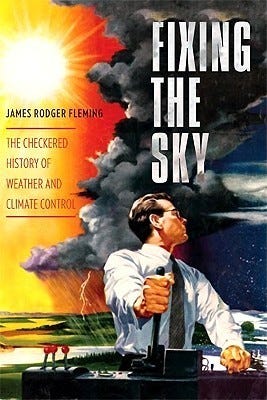
Fleming’s book is mostly about rain-making. For about two centuries, a succession of charlatans and true believers promised local governments they could make it rain, collected their fees, and produced no evidence they’d done anything at all. Fleming traces this history with obvious relish and considerable irritation, and he builds toward a thesis: people who claim they can control the weather have almost always been wrong, often fraudulently so, and we should be deeply suspicious of anyone making similar claims today.
The rain-makers aren’t what stuck with me, though. Chapter seven is where Fleming gets to the proposals that changed how an entire scientific field thinks about intervention. And reading them, you start to understand his suspicion, because for most of the twentieth century, serious people with real credentials proposed doing absolutely unhinged things to the planet’s climate.
For most of the twentieth century, serious people with real credentials proposed doing absolutely unhinged things to the planet’s climate.
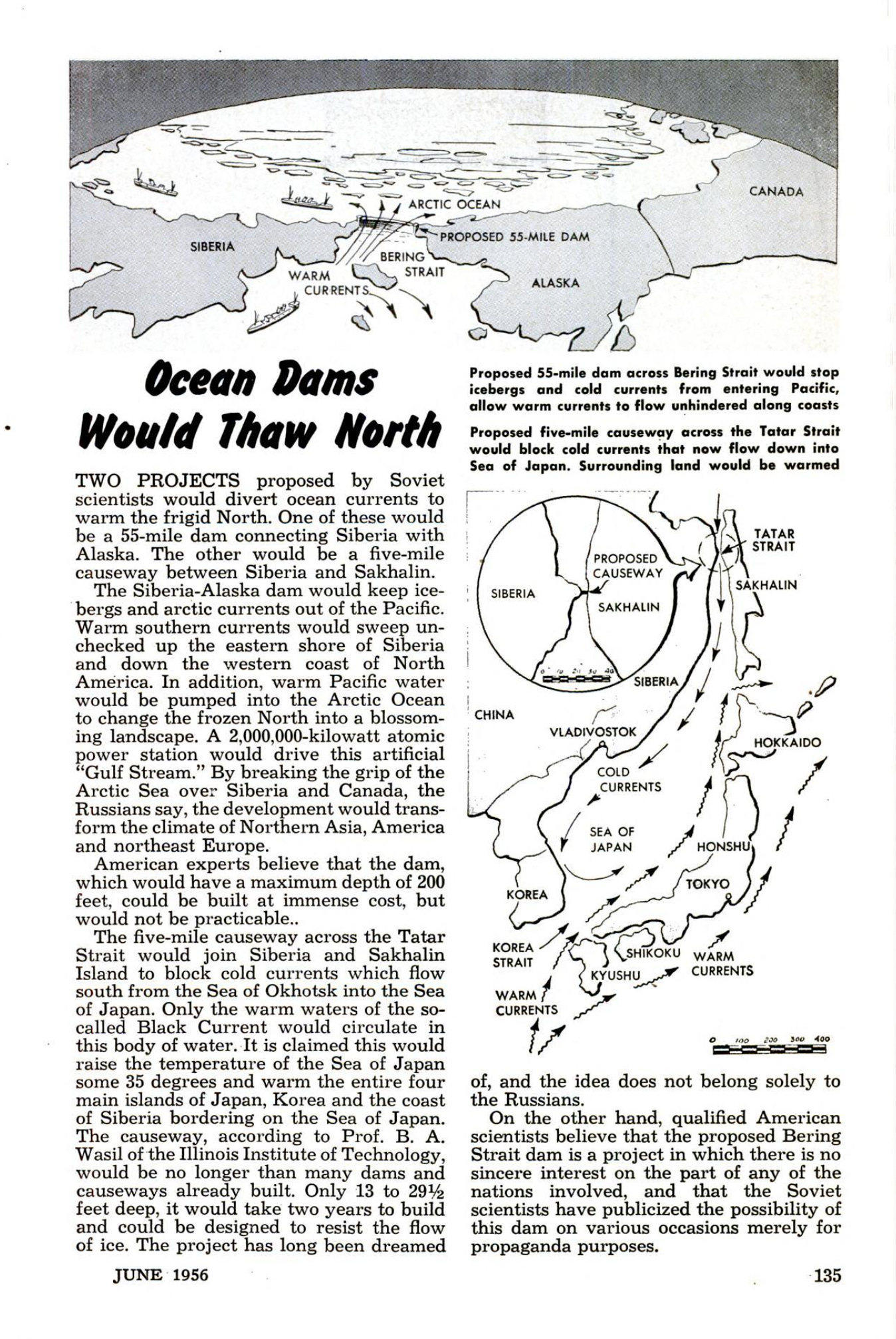
Hermann Sörgel wanted to dam the Strait of Gibraltar and lower the Mediterranean Sea, opening millions of acres for European settlement while irrigating Africa by damming the Congo. Soviet engineers proposed a dam fifty miles long across the Bering Strait that would block cold water coming out of the Arctic Ocean and into the Pacific, while letting warmer Atlantic water flow in and melt the ice caps (though this one might have been just for propaganda purposes—which actually supports my broader point). Someone wanted to cut holes in the ozone layer so astronomers could get better telescope observations. And the US military actually went through with one of these proposals. Project West Ford launched hundreds of millions of tiny copper antenna needles into orbit to create an artificial ionosphere for communications. Some of those needles are still up there.
The people proposing these ideas weren’t necessarily cranks. Harry Wexler was Chief of the Scientific Services Division at the U.S. Weather Bureau, and a central figure in early satellite meteorology, including work with TIROS‑1, the first weather satellite. He championed and helped secure U.S. Weather Bureau support for the atmospheric CO₂ measurements at Mauna Loa and the South Pole that became the Keeling Curve, and was one of the most accomplished meteorologists of the 20th century. In the late 1950s and early 1960s, he outlined schemes to raise global temperature by detonating ten hydrogen bombs over Arctic sea ice, to cool the planet by launching a ring of dust particles into equatorial orbit, and to destroy the stratospheric ozone layer using catalytic agents such as chlorine or bromine. That last idea was actually prescient. He was describing catalytic reactions by chlorine and bromine that could destroy the ozone layer more than a decade before the seminal work by Paul Crutzen, Mario Molina, and Sherwood Rowland that ultimately earned them the 1995 Nobel Prize in Chemistry. He died of a heart attack at 51 that summer, before he could publish his detailed ozone‑destruction calculations.
And then there’s the 1965 President’s Science Advisory Committee report, Restoring the Quality of Our Environment, which may be the most revealing document of all. The committee understood that CO₂ was accumulating in the atmosphere and would warm the planet. Their concrete response was to propose spreading reflective particles over the ocean to bounce sunlight back into space. Reducing fossil fuel use wasn't part of the conversation. Modifying the climate to suit our preferences was the obvious first move and not a “reluctant” last resort.
Fleming reads all of this and sees hubris all the way down. And for most of this history, I come away convinced that he’s right. What all these proposals shared was a posture of mastery. It was humanity reshaping the climate because it could, because someone thought it would be useful, and because the Arctic would be more “productive” without all that ice. There’s a famous C.S. Lewis quote about this:
What we call Man’s power over Nature turns out to be a power exercised by some men over other men with Nature as its instrument.
They're both making the same point. Taking enormous risks with the entire planet out of an arrogance of mastery is wrong, and I agree with them.
The encoding of an objection
Now, these are all interesting in terms of historical anecdotes, but these proposals are actually more than just bad ideas, because academic fields don’t just remember bad ideas. They encode them as worthy of rejection. And over time, it became normalized to reject large-scale climate interventions because that was the responsible position. This happened through citation chains and literature reviews, through the way canonical texts frame what counts as serious scholarship, and through peer review norms and the informal culture of what gets you taken seriously at conferences versus what gets you sideways looks. You absorb this through professional formation. A climate scientist in 2026 doesn’t need to have specifically read about Wexler’s hydrogen bombs or Project West Ford to adopt the institutional view that large-scale interventions are hubristic. The field carries the lesson forward.
And the lesson that crystallized was broad. It wasn’t just that specific proposals were dangerous—it was that anything resembling the mastery posture was suspect. This is routinely brought up as an objection to climate interventions by serious people who think that they could substitute for or delay the hard work of cutting emissions. Johan Rockström says in the video linked below that SRM is not an option because “It allows the world to release the little pressure we have on the accelerator of decarbonizing the global economy.”
The UNFCCC established mitigation as the central project of climate policy, and the scientific community organized its identity around that project. The heuristic became: if someone is proposing something other than emissions reduction, they’re either naive or they’re running interference for the people who caused the problem.
I’ve written before about encountering this firsthand at the Global Tipping Points Conference (where that video was recorded). There I sat through days of presentations on civilizational-scale risks and watched the community that produced those presentations decline to discuss what we might do about them on relevant timescales. During a coffee break, a scientist I’d just met, upon learning I was interested in how we’d actually respond to tipping point risks, moved almost immediately to the position that carbon dioxide removal and geoengineering are just being advocated for on behalf of oil and gas. I was at this incredibly niche academic conference because I’d spent years working on CDR and was genuinely trying to understand the tipping point literature. The condescension was remarkable.
But that’s what the heuristic produces. It creates an asymmetry where the risks of intervening get scrutinized exhaustively and the risks of not investigating barely register as a question worth asking. Across funders, conservation organizations, and researchers, the pattern is consistent: any proposal for deliberate climate action beyond emissions reduction triggers this immune response of rejection. And whatever the merits of that response in the twentieth century, it’s now operating in a very different world than the one that produced it.
The situation changed; the heuristic didn’t
We temporarily breached 1.5°C in 2024. We’ve added well over a trillion tonnes of CO₂ to the atmosphere. Ice sheets are losing mass. Methane release is accelerating. Tipping point risks that were theoretical projections twenty years ago are becoming observable trends. The status quo that justified the old asymmetry—where inaction was roughly equivalent to safety—doesn’t exist anymore.
The 20th century proposals were about improvement. Those engineers wanted to make climates more convenient, open new land for settlement, and melt ice because someone thought it would be economically useful. But the serious researchers proposing interventions today are doing something fundamentally different. They're trying to manage risk under worsening conditions. The people whose work gets characterized as reckless are mostly arguing that we should do careful research so we understand the options before we need them. Research to better understand our options for managing risk is not reckless—it’s responsible.
And there’s an irony I keep coming back to as well. The intellectual framework that makes the strongest case for at least investigating faster-acting climate tools—complex systems thinking, nonlinear dynamics, tipping point cascades, the understanding that small perturbations can trigger irreversible large-scale shifts—was built by the same researchers who are most resistant to engaging with those tools. Their own science shows that the risks of the next few decades may not wait for the slower solutions (decarbonization and carbon dioxide removal) to scale. The professional identity they’ve built around that science is the thing preventing them from following it to its conclusion.
That’s what an immune response looks like when it starts attacking something the body needs. The caution was earned. But I think it’s now doing more harm than what it was designed to protect against. The heuristic trained an entire field to ask one question—what are the risks of intervening?—and that question deserves rigorous answers. But there’s a second question that barely gets asked, and it deserves equal rigor: what are the risks of not investigating these tools while we still have time to understand them?
This and every other article I publish is free because I want these ideas to reach as many people as possible. Paid subscriptions are how I keep doing this work independently. They allow me to follow the research on climate interventions and meet the researchers, practitioners, founders, and policymakers shaping how this landscape evolves.
Paid members get access to our community chat, where we discuss the latest developments in climate interventions and make sense of them together. I’m sharing all the really interesting videos, papers, stories, and other links I’m coming across in there. If you’ve found value in this newsletter, I’d appreciate your support.
Johan also said on the same video that SRM side effects “can/will be catastrophic themselves.”
Which is quite a remarkable statement from someone who could be called given his prominence and leadership the Chief Climate Officer of the Earth.
I am aware of no model historic analogy or even theoretical conclusion that the deployment of SRM would likely be catastrophic.
Your observation that the tipping points community as demonstrated in Exeter last year - the group who has led the world in exploring and understanding these catastrophically dangerous often irreversible tipping elements - remains almost universally opposed to efforts to cool the planet.
You propose a very plausible explanation for why their opposition continues even as it has become clear that ERA - emission reductions alone - have passed the point where it can prevent the end of civilization as we know it in the coming decades, even were these reductions accelerated.
Brilliant scientists are acting totally contrary to the basic tenets of the profession they devote their lives to - open mindedness to new evidence, continuing efforts to disprove their hypotheses, and an objectivity reinforced by years if not decades of absorbing the ideals of the scientific culture.
Typically for a paradigm to be weakened enough to be replaced with a different paradigm the generation holding guard if you will over that paradigm needs to pass on.
Unfortunately the world doesn’t have time to allow that to happen in the hopes that the next generation will not be stricken by the same condition.
What an unholy mess we are in where those dedicated scientists - with a very few exceptions like Jim Hansen and Mike Maccracken - are the very people holding back an extremely promising remedy that could dramatically reduce suffering death and the collapse of ecosystems for generations.